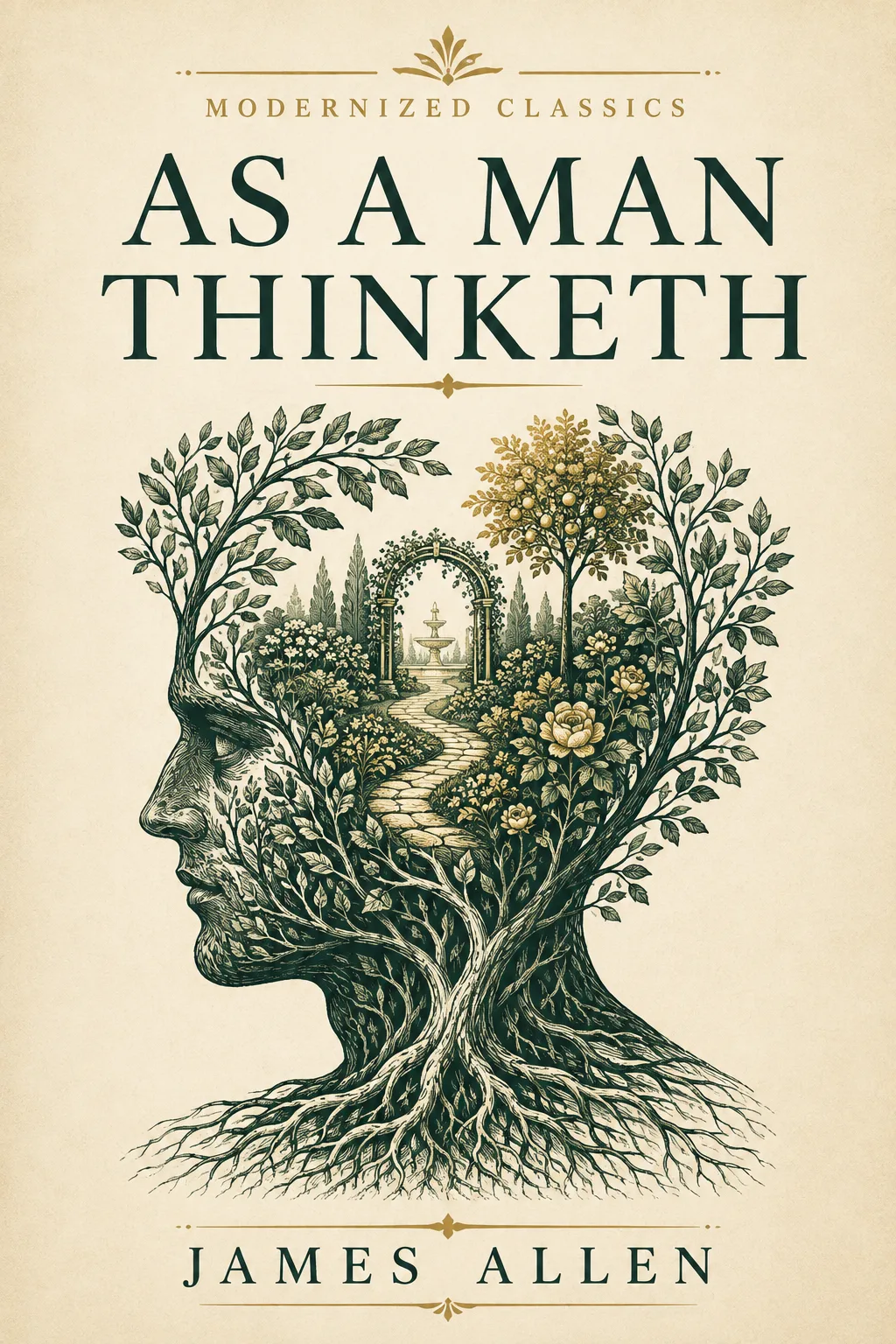
Mind is the master power that molds and makes,
And Man is Mind, and he forever takes
The tool of Thought, and, shaping what he wills,
Brings forth a thousand joys, a thousand ills:—
He thinks in secret, and it comes to pass:
Environment is but his looking-glass.
FOREWORD
This little book grew out of meditation and experience. It is not meant to be a complete treatise on the power of thought, a subject many have already written about. It aims to suggest rather than to explain. Its purpose is to encourage men and women to discover and see for themselves the truth that—
“They themselves are makers of themselves.”
They do this through the thoughts they choose and encourage. The mind is the master-weaver of both the inner garment of character and the outer garment of circumstance. Until now they may have woven in ignorance and pain, but they can now weave in understanding and happiness.
JAMES ALLEN.
BROAD PARK AVENUE,
ILFRACOMBE,
ENGLAND
THOUGHT AND CHARACTER
The saying “As a man thinketh in his heart so is he” covers the whole of a man’s being, and it reaches further still, extending to every condition and circumstance of his life. A man is literally what he thinks. His character is the complete sum of all his thoughts.
A plant grows from a seed and could not exist without it. In the same way, every act a man performs grows from hidden seeds of thought and could not have appeared without them. This applies just as much to acts we call “spontaneous” or “unpremeditated” as to acts carried out deliberately.
Action is the blossom of thought, and joy and suffering are its fruits. In this way a man gathers the sweet and bitter harvest of his own farming.
“Thought in the mind has made us. What we are
By thought was shaped and built. If a man’s mind
Has evil thoughts, pain comes on him as comes
The wheel that follows the ox…..If one endures
In purity of thought, joy follows him
As his own shadow—sure.”
Man grows according to law; he is not a product of artifice. Cause and effect work just as absolutely and unfailingly in the hidden realm of thought as in the world of visible, material things.
A noble and Godlike character is not a matter of favor or chance. It is the natural result of continued effort in right thinking, the effect of a long and cherished association with Godlike thoughts. By the same process, an ignoble and bestial character results from continually harboring low, groveling thoughts.
Man makes or unmakes himself. In the armory of thought he forges the weapons with which he destroys himself. There he also shapes the tools with which he builds himself heavenly mansions of joy, strength, and peace.
By choosing thought rightly and applying it truly, man rises to Divine Perfection. By abusing thought and applying it wrongly, he sinks below the level of the beast. Between these two extremes lie all the degrees of character, and man is their maker and master.
Many beautiful truths about the soul have been restored and brought to light in this age. None is more gladdening, or more full of divine promise and confidence, than this: man is the master of thought, the molder of character, and the maker and shaper of his condition, environment, and destiny.
Man is a being of Power, Intelligence, and Love, and the lord of his own thoughts. He therefore holds the key to every situation. He carries within himself the transforming and renewing force by which he can make himself whatever he wills.
Man is always the master, even when he is at his weakest and most abandoned. But in weakness and degradation he is a foolish master who mismanages his “household.”
When he begins to reflect on his condition and to search carefully for the Law on which his being rests, he becomes a wise master. He directs his energies intelligently and shapes his thoughts toward fruitful results. This is the conscious master.
A man can become this kind of master only by discovering the laws of thought within himself. That discovery depends entirely on effort, self-analysis, and experience.
Gold and diamonds are found only through long searching and mining. In the same way, man can find every truth about his own being if he digs deep into the mine of his soul.
He can prove beyond doubt that he makes his character, molds his life, and builds his destiny. To do so, he must watch, control, and change his thoughts, tracing their effects on himself, on others, and on his life and circumstances. He must connect cause and effect through patient practice and investigation.
He must also use every experience, down to the most trivial everyday event, as a way of gaining the knowledge of himself that is Understanding, Wisdom, and Power.
In this area, as in no other, the law holds absolutely: “He that seeketh findeth; and to him that knocketh it shall be opened.” Only through patience, practice, and relentless persistence can a man enter the Door of the Temple of Knowledge.
EFFECT OF THOUGHT ON CIRCUMSTANCES
A man’s mind is like a garden. It can be cultivated intelligently or left to run wild. But whether it is tended or neglected, it must and will produce something. If no useful seeds are planted in it, plenty of useless weed seeds will fall into it, and they will keep producing more of their kind.
A gardener works his plot, keeps it free of weeds, and grows the flowers and fruits he needs. In the same way, a man can tend the garden of his mind. He can weed out all wrong, useless, and impure thoughts, and cultivate toward perfection the flowers and fruits of right, useful, and pure thoughts.
By following this process, a man sooner or later discovers that he is the master-gardener of his soul and the director of his life. He also uncovers the laws of thought within himself. With ever-growing accuracy, he comes to understand how the forces of thought and the elements of mind work to shape his character, circumstances, and destiny.
Thought and character are one. Character can show itself and come to be known only through environment and circumstance. For this reason, the outer conditions of a person’s life will always be found to correspond to his inner state.
This does not mean that a man’s circumstances at any given moment reveal his whole character. It means that those circumstances are so closely connected with some vital element of thought within him that, for the time being, they are necessary for his development.
Every man is where he is by the law of his own being. The thoughts he has built into his character have brought him there. There is no element of chance in how his life is arranged; everything results from a law that cannot err. This is just as true of people who feel “out of harmony” with their surroundings as of those who are content with them.
Man is a being who progresses and evolves. He is where he is so that he may learn, and so that he may grow. As he learns the spiritual lesson a circumstance holds for him, that circumstance passes away and gives way to others.
As long as a man believes he is the product of outside conditions, circumstances knock him about. But when he realizes that he is a creative power, and that he can command the hidden soil and seeds of his being from which circumstances grow, he becomes the rightful master of himself.
Anyone who has practiced self-control and self-purification for any length of time knows that circumstances grow out of thought. He will have noticed that his circumstances changed in exact proportion to the change in his mental condition.
This is so true that when a man earnestly works to correct the flaws in his character and makes rapid, marked progress, he passes quickly through a series of ups and downs.
The soul attracts what it secretly harbors: what it loves, and also what it fears. It rises to the height of its cherished aspirations. It falls to the level of its undisciplined desires. Circumstances are the means by which the soul receives what belongs to it.
Every thought-seed that is planted, or allowed to fall into the mind and take root, produces its own kind. Sooner or later it blossoms into action and bears its own fruit of opportunity and circumstance. Good thoughts bear good fruit; bad thoughts bear bad fruit.
The outer world of circumstance shapes itself to the inner world of thought. Both pleasant and unpleasant outer conditions work toward the ultimate good of the individual. As the one who reaps his own harvest, man learns through both suffering and joy.
A man follows the inmost desires, aspirations, and thoughts that he allows to rule him. He may chase the will-o’-the-wisps of impure imaginings. Or he may walk steadily along the highway of strong and high effort.
Either way, he finally reaches their fruition and fulfillment in the outer conditions of his life. The laws of growth and adjustment hold everywhere.
A man does not end up in the almshouse or the jail through the tyranny of fate or circumstance. He arrives there by the path of groveling thoughts and base desires.
Nor does a pure-minded man suddenly fall into crime because of some merely external pressure. The criminal thought had long been secretly nourished in his heart, and the moment of opportunity revealed the power it had gathered.
Circumstance does not make the man; it reveals him to himself. No one can sink into vice and its accompanying suffering without vicious inclinations. No one can rise into virtue and its pure happiness without steadily cultivating virtuous aspirations.
Man, therefore, as the lord and master of thought, is the maker of himself and the shaper and author of his environment. Even at birth the soul comes into what belongs to it. At every step of its earthly pilgrimage it attracts the combinations of conditions that reveal it, conditions that reflect its own purity and impurity, its strength and weakness.
Men do not attract what they want, but what they are. Their whims, fancies, and ambitions are blocked at every turn. Yet their inmost thoughts and desires are fed with their own kind of food, whether foul or clean.
The “divinity that shapes our ends” lies within us; it is our very self. Man is chained by no one but himself. Thought and action are the jailers of Fate: when they are base, they imprison. They are also the angels of Freedom: when they are noble, they set free.
A man does not get what he wishes and prays for, but what he justly earns. His wishes are granted and his prayers answered only when they agree with his thoughts and actions.
In light of this truth, what does “fighting against circumstances” mean? It means that a man is constantly rebelling against an outward effect while all along he is nourishing and preserving its cause in his heart.
That cause may be a conscious vice or an unconscious weakness. Whatever form it takes, it stubbornly holds back the efforts of the person who has it, and so it cries out to be remedied.
People are eager to improve their circumstances but unwilling to improve themselves, and so they remain bound. The man who does not shrink from crucifying his own self can never fail to reach the goal his heart is set on. This is as true of earthly matters as of heavenly ones.
Even a man whose only goal is to gain wealth must be ready to make great personal sacrifices before he succeeds. How much more must someone sacrifice who wants to achieve a strong and well-balanced life?
Here is a man who is wretchedly poor. He badly wants his surroundings and home comforts improved. Yet all the while he avoids his work, and he thinks he is justified in trying to deceive his employer because his wages are too low.
Such a man does not understand even the simplest basics of the principles on which true prosperity rests. He is not only completely unfit to rise out of his misery. By dwelling on and acting out lazy, deceptive, and unmanly thoughts, he is actually drawing a still deeper misery to himself.
Here is a rich man who suffers from a painful, persistent disease caused by gluttony. He is willing to pay large sums to be rid of it, but he will not give up his gluttonous desires. He wants to indulge his taste for rich and unnatural dishes and keep his health as well.
Such a man is completely unfit to have health, because he has not yet learned the first principles of a healthy life.
Here is an employer who uses crooked methods to avoid paying the standard wage, and who cuts his workers’ pay in the hope of larger profits. Such a man is entirely unfit for prosperity. When he finds himself bankrupt in both reputation and wealth, he blames circumstances, not realizing that he alone has caused his condition.
I have introduced these three cases only to illustrate a truth: man causes his own circumstances, though almost always without knowing it. While aiming at a good end, he constantly defeats it by encouraging thoughts and desires that cannot possibly agree with that end.
Such cases could be multiplied and varied almost endlessly, but there is no need. If the reader resolves to do so, he can trace the working of the laws of thought in his own mind and life. Until he does, mere external facts cannot provide a basis for reasoning.
Circumstances, however, are very complicated. Thought is deeply rooted, and the conditions of happiness differ greatly from one person to another. For these reasons, no one can judge another man’s entire inner condition from the outward appearance of his life alone, even though the man himself may know it.
A man may be honest in some respects and still suffer hardship. Another may be dishonest in some respects and still grow wealthy. People usually conclude that the first man fails because of his particular honesty, and that the second prospers because of his particular dishonesty.
This is a superficial judgment. It assumes that the dishonest man is almost wholly corrupt and the honest man almost wholly virtuous. Deeper knowledge and wider experience show that this judgment is mistaken. The dishonest man may have admirable virtues that the honest man lacks. The honest man may have offensive vices that the dishonest man does not have.
The honest man reaps the good results of his honest thoughts and acts. He also brings on himself the suffering that his vices produce. The dishonest man, likewise, gathers in both his own suffering and his own happiness.
It flatters human vanity to believe that we suffer because of our virtue. But a man must first root out every sickly, bitter, and impure thought from his mind and wash every sinful stain from his soul. Only then is he in a position to know and declare that his sufferings come from his good qualities and not from his bad ones.
Long before he reaches that supreme perfection, while he is still on the way to it, he will have found the Great Law at work in his mind and life. That Law is absolutely just. It therefore cannot return good for evil, or evil for good.
With this knowledge, he will look back on his former ignorance and blindness and see that his life is, and always was, justly ordered. All his past experiences, good and bad, were the fair working-out of a self that was evolving but not yet fully evolved.
Good thoughts and actions can never produce bad results. Bad thoughts and actions can never produce good results. This is simply saying that nothing can grow from corn but corn, and nothing from nettles but nettles.
People understand this law in the natural world, and they work with it. Few understand it in the mental and moral world, though it operates there just as simply and unfailingly. Because they do not understand it there, they do not cooperate with it.
Suffering is always the effect of wrong thought in some direction. It shows that a person is out of harmony with himself, with the Law of his being. The one supreme use of suffering is to purify, to burn away everything that is useless and impure.
Suffering ends for the person who is pure. Gold is heated to burn off its impurities, the dross. Once the dross is gone, there is no point in burning the gold further. In the same way, a perfectly pure and enlightened being could not suffer.
The circumstances that a man meets with suffering are the result of his own inner disharmony. The circumstances that he meets with blessedness are the result of his own inner harmony.
Blessedness, not material possessions, is the measure of right thought. Wretchedness, not a lack of material possessions, is the measure of wrong thought. A man may be cursed and rich, and he may be blessed and poor.
Blessedness and riches go together only when the riches are used rightly and wisely. And a poor man sinks into wretchedness only when he regards his lot as a burden unjustly laid on him.
Indigence and indulgence, extreme want and excess, are the two extremes of wretchedness. Both are equally unnatural, and both result from mental disorder.
A man is not in his proper condition until he is happy, healthy, and prosperous. Happiness, health, and prosperity come from a harmonious adjustment of the inner life with the outer, of the man with his surroundings.
A man only begins to be truly a man when he stops whining and blaming, and starts searching for the hidden justice that governs his life.
As he adapts his mind to that governing principle, he stops accusing others as the cause of his condition. Instead, he builds himself up through strong and noble thoughts. He stops kicking against his circumstances and begins to use them to speed his progress, and as a way of discovering the hidden powers and possibilities within himself.
Law, not confusion, is the ruling principle of the universe. Justice, not injustice, is the soul and substance of life. Righteousness, not corruption, is the force that shapes and moves the spiritual government of the world.
Since this is so, a man has only to set himself right to find that the universe is right. And while he is putting himself right, he will find that as he changes his thoughts toward things and other people, things and other people will change toward him.
The proof of this truth lies within every person, so anyone can easily investigate it through systematic introspection and self-analysis. Let a man radically change his thoughts, and he will be astonished at how quickly this transforms the material conditions of his life.
People imagine that thought can be kept secret, but it cannot. Thought quickly crystallizes into habit, and habit solidifies into circumstance.
Bestial thoughts crystallize into habits of drunkenness and sensuality, which solidify into circumstances of destitution and disease. Impure thoughts of every kind crystallize into draining and confusing habits, which solidify into distracting and adverse circumstances.
Thoughts of fear, doubt, and indecision crystallize into weak, unmanly, and irresolute habits, which solidify into circumstances of failure, poverty, and slavish dependence. Lazy thoughts crystallize into habits of uncleanliness and dishonesty, which solidify into circumstances of filth and beggary.
Hateful and condemning thoughts crystallize into habits of accusation and violence, which solidify into circumstances of injury and persecution. Selfish thoughts of all kinds crystallize into habits of self-seeking, which solidify into circumstances that are more or less distressing.
On the other hand, beautiful thoughts of all kinds crystallize into habits of grace and kindness, which solidify into warm and sunny circumstances. Pure thoughts crystallize into habits of temperance and self-control, which solidify into circumstances of rest and peace.
Thoughts of courage, self-reliance, and decision crystallize into manly habits, which solidify into circumstances of success, plenty, and freedom. Energetic thoughts crystallize into habits of cleanliness and hard work, which solidify into pleasant circumstances.
Gentle and forgiving thoughts crystallize into habits of gentleness, which solidify into protective and preserving circumstances. Loving and unselfish thoughts crystallize into habits of forgetting oneself for the sake of others, which solidify into circumstances of sure and lasting prosperity and true riches.
A particular line of thought, if persisted in, cannot fail to produce its results on a man’s character and circumstances, whether it is good or bad. A man cannot directly choose his circumstances. But he can choose his thoughts, and so, indirectly yet surely, he can shape his circumstances.
Nature helps every man to satisfy the thoughts he most encourages. Opportunities arise that will most quickly bring both his good and his evil thoughts to the surface.
Let a man give up his sinful thoughts, and the whole world will soften toward him and be ready to help him. Let him put away his weak and sickly thoughts, and opportunities will spring up on every side to support his strong resolutions. Let him encourage good thoughts, and no hard fate will hold him down in wretchedness and shame.
The world is your kaleidoscope. As you turn that tube of colored glass, it shows you a new pattern at every moment. In the same way, the changing combinations of color the world presents to you are finely adjusted pictures of your ever-moving thoughts.
“So you will be what you will to be;
Let failure find its false content
In that poor word, ‘environment,‘
But spirit scorns it, and is free.
“It masters time, it conquers space;
It cows that boastful trickster, Chance,
And bids the tyrant Circumstance
Uncrown, and fill a servant’s place.
“The human Will, that force unseen,
The offspring of a deathless Soul,
Can hew a way to any goal,
Though walls of granite intervene.
“Be not impatient in delays
But wait as one who understands;
When spirit rises and commands
The gods are ready to obey.”
EFFECT OF THOUGHT ON HEALTH AND THE BODY
The body is the servant of the mind. It obeys the workings of the mind, whether those workings are deliberately chosen or expressed automatically.
When unlawful thoughts give the orders, the body quickly sinks into disease and decay. When glad and beautiful thoughts give the orders, the body becomes clothed with youthfulness and beauty.
Disease and health, like circumstances, are rooted in thought. Sickly thoughts will express themselves through a sickly body.
Thoughts of fear have been known to kill a man as quickly as a bullet. They are continually killing thousands of people just as surely, though more slowly. The people who live in fear of disease are the people who catch it.
Anxiety quickly weakens the whole body and leaves it open to disease. Impure thoughts, even if they are never physically acted on, will soon shatter the nervous system.
Strong, pure, and happy thoughts build up the body in vigor and grace. The body is a delicate and flexible instrument. It responds readily to the thoughts that impress themselves on it, and habits of thought will produce their own effects on it, good or bad.
People will go on having impure and poisoned blood as long as they keep breeding unclean thoughts. A clean heart produces a clean life and a clean body. A defiled mind produces a defiled life and a corrupt body.
Thought is the source of action, of life, and of everything that shows itself outwardly. Make the source pure, and everything that flows from it will be pure.
A change of diet will not help a man who will not change his thoughts. When a man makes his thoughts pure, he no longer desires impure food.
Clean thoughts make clean habits. The so-called saint who does not wash his body is not a saint. The man who has strengthened and purified his thoughts does not need to worry about the malevolent microbe.
If you want to protect your body, guard your mind. If you want to renew your body, make your mind beautiful. Thoughts of malice, envy, disappointment, and despondency rob the body of its health and grace.
A sour face does not come about by chance. It is made by sour thoughts. Disfiguring wrinkles are drawn by folly, passion, and pride.
I know a woman of ninety-six who has the bright, innocent face of a girl. I know a man well under middle age whose face is drawn into distorted, discordant lines. The first is the result of a sweet and sunny disposition. The second is the outcome of passion and discontent.
A home cannot be fresh and wholesome unless air and sunshine are let freely into its rooms. In the same way, a strong body and a bright, happy, or serene face can only come from freely letting thoughts of joy, goodwill, and serenity into the mind.
On the faces of the old, some wrinkles are made by sympathy, others by strong and pure thought, and others are carved by passion. Who cannot tell them apart?
For those who have lived righteously, old age is calm, peaceful, and gently mellowed, like the setting sun. I recently saw a philosopher on his deathbed. He was not old except in years. He died as sweetly and peacefully as he had lived.
No physician can match cheerful thought for driving away the ills of the body. No comforter can compare with goodwill for dispersing the shadows of grief and sorrow. To live constantly in thoughts of ill will, cynicism, suspicion, and envy is to be locked in a prison cell of one’s own making.
But to think well of everyone, to be cheerful with everyone, and to patiently learn to find the good in everyone: such unselfish thoughts are the very gates of heaven. And to live day after day in thoughts of peace toward every creature will bring abundant peace to the person who holds them.
THOUGHT AND PURPOSE
Until thought is linked with purpose, nothing is accomplished intelligently. Most people let the small ship of their thought drift on the ocean of life. Aimlessness is a vice. Anyone who wants to steer clear of disaster and destruction must not go on drifting.
Those who have no central purpose in life fall easy prey to petty worries, fears, troubles, and self-pity. All of these are signs of weakness.
Weakness leads to failure, unhappiness, and loss just as surely as deliberately planned sins do, though by a different route. Weakness cannot last in a universe where power is always evolving.
A man should form a legitimate purpose in his heart and set out to accomplish it. He should make this purpose the central point of his thoughts.
It may take the form of a spiritual ideal, or it may be a worldly goal, depending on his nature at the time. Whichever it is, he should steadily focus the forces of his thought on the goal he has set before himself.
He should make this purpose his supreme duty and devote himself to achieving it. He should not let his thoughts wander off into passing fancies, longings, and daydreams. This is the royal road to self-control and true concentration of thought.
He may fail again and again to accomplish his purpose, as he inevitably must until he has overcome his weakness. Even so, the strength of character he gains will be the measure of his true success. That strength will become a new starting point for future power and triumph.
Some people are not yet ready to grasp a great purpose. They should fix their thoughts on doing their duty perfectly, however unimportant their task may seem.
Only in this way can their thoughts be gathered and focused, and their resolution and energy developed. Once that has been done, there is nothing that cannot be accomplished.
The weakest soul, aware of its own weakness, need only believe one truth: strength can be developed only through effort and practice. Believing this, it will begin at once to exert itself. Adding effort to effort, patience to patience, and strength to strength, it will never stop developing, and in the end it will grow divinely strong.
A physically weak man can make himself strong through careful and patient training. In the same way, a man whose thoughts are weak can make them strong by exercising himself in right thinking.
To put aside aimlessness and weakness and begin to think with purpose is to join the ranks of the strong. These are people who see failure as only one of the paths to achievement. They make every condition serve them. They think strongly, attempt fearlessly, and accomplish masterfully.
Once a man has formed his purpose, he should mentally mark out a straight path toward achieving it, looking neither right nor left. He should firmly shut out doubts and fears. These are forces that break things apart. They disrupt the straight line of effort and make it crooked, ineffective, and useless.
Thoughts of doubt and fear have never accomplished anything, and they never can. They always lead to failure. Purpose, energy, the power to act, and every strong thought come to an end once doubt and fear creep in.
The will to act grows out of the knowledge that we can act. Doubt and fear are the great enemies of that knowledge. Whoever encourages them, instead of destroying them, defeats himself at every step.
Whoever has conquered doubt and fear has conquered failure. Every one of his thoughts is joined to power, and he meets every difficulty bravely and overcomes it wisely. His purposes are planted in their proper season. They bloom and bear fruit, and the fruit does not fall to the ground before it ripens.
When thought is fearlessly joined to purpose, it becomes a creative force. Whoever knows this is ready to become something higher and stronger than a mere bundle of wavering thoughts and shifting sensations. Whoever does this has become the conscious and intelligent master of his mental powers.
THE THOUGHT-FACTOR IN ACHIEVEMENT
Everything a man achieves, and everything he fails to achieve, is the direct result of his own thoughts. The universe is justly ordered, and in such a universe any loss of balance would mean total destruction. Individual responsibility must therefore be absolute.
A man’s weakness and strength, his purity and impurity, belong to him and not to anyone else. He brings them about himself; no one else does. Only he can change them; no one else ever can. His condition, too, is his own and not another’s. His suffering and his happiness develop from within. As he thinks, so he is; as he goes on thinking, so he remains.
A strong man cannot help a weaker one unless the weaker man is willing to be helped. Even then, the weak man must become strong on his own. Through his own efforts, he must develop the strength he admires in the other. No one but himself can change his condition.
People have usually thought and said, “Many men are slaves because one man is an oppressor; let us hate the oppressor.” Now, however, a growing few tend to reverse this judgment. They say, “One man is an oppressor because many are slaves; let us despise the slaves.”
The truth is that oppressor and slave cooperate in ignorance. They seem to afflict each other, but in reality each is afflicting himself. Perfect Knowledge sees law at work both in the weakness of the oppressed and in the misused power of the oppressor. Perfect Love sees the suffering both conditions bring and condemns neither. Perfect Compassion embraces both oppressor and oppressed.
Whoever has conquered weakness and put away all selfish thoughts belongs to neither side, oppressor or oppressed. He is free.
A man can rise, conquer, and achieve only by lifting up his thoughts. He can remain weak, degraded, and miserable only by refusing to lift them up.
Before a man can achieve anything, even in worldly matters, he must raise his thoughts above slavish animal indulgence. To succeed, he need not give up all of his animal nature and selfishness, not by any means. But he must sacrifice at least some portion of it.
A man whose first thought is brute indulgence could neither think clearly nor plan methodically. He could not find and develop his hidden resources, and he would fail at anything he tried. Because he has not begun to take manly control of his thoughts, he is in no position to control affairs or take on serious responsibilities. He is not fit to act independently and stand on his own. Yet the only limits on him are the thoughts he chooses.
There can be no progress and no achievement without sacrifice. A man’s worldly success will match the degree to which he sacrifices his confused animal thoughts and fixes his mind on developing his plans and strengthening his resolution and self-reliance.
The higher he lifts his thoughts, the more manly, upright, and righteous he becomes. And the more he becomes so, the greater his success will be, and the more blessed and lasting his achievements.
The universe does not favor the greedy, the dishonest, or the vicious, though on the surface it may sometimes appear to. It helps the honest, the generous, and the virtuous. All the great Teachers of the ages have declared this in different forms. To prove and know it for himself, a man need only keep making himself more and more virtuous by lifting up his thoughts.
Intellectual achievements come from thought devoted to the search for knowledge, or for what is beautiful and true in life and nature. Such achievements are sometimes linked with vanity and ambition, but they do not come from those traits. They grow naturally out of long, hard effort and out of pure and unselfish thoughts.
Spiritual achievements are the fulfillment of holy aspirations. Someone who lives constantly with noble and lofty thoughts, and who dwells on everything pure and unselfish, will become wise and noble in character. He will rise into a position of influence and blessedness as surely as the sun reaches its highest point and the moon becomes full.
Achievement of any kind is the crown of effort, the diadem of thought. With the help of self-control, resolution, purity, righteousness, and well-directed thought, a man rises. Through animal appetite, laziness, impurity, corruption, and confused thinking, a man falls.
A man may rise to great success in the world, and even to lofty heights in the spiritual realm, and then fall again into weakness and misery. This happens when he lets arrogant, selfish, and corrupt thoughts take hold of him.
Victories won by right thought can be kept only through watchfulness. Many people relax once success seems certain, and they quickly slide back into failure.
All achievements, whether in business, intellectual, or spiritual life, result from thought that is directed toward a definite end. They are governed by the same law and follow the same method. The only difference is the object being pursued.
Whoever would accomplish little must sacrifice little. Whoever would achieve much must sacrifice much. Whoever would reach great heights must sacrifice greatly.
VISIONS AND IDEALS
The dreamers are the saviors of the world. The visible world is sustained by the invisible one. In the same way, people are nourished, through all their trials, sins, and sordid occupations, by the beautiful visions of their solitary dreamers.
Humanity cannot forget its dreamers. It cannot let their ideals fade and die. It lives in them, and it knows them as the realities it will one day see and know.
The composer, sculptor, painter, poet, prophet, and sage are the makers of the world to come, the architects of heaven. The world is beautiful because they have lived. Without them, laboring humanity would perish.
Whoever cherishes a beautiful vision, a lofty ideal in his heart, will one day make it real. Columbus cherished the vision of another world, and he discovered it. Copernicus nurtured the vision of many worlds and a wider universe, and he revealed it. Buddha saw the vision of a spiritual world of spotless beauty and perfect peace, and he entered it.
Cherish your visions. Cherish your ideals. Cherish the music that stirs in your heart, the beauty that takes shape in your mind, and the loveliness that clothes your purest thoughts. Out of them will grow every delightful condition and every heavenly environment. If you only remain true to them, your world will at last be built from them.
To desire is to obtain; to aspire is to achieve. Should a man’s lowest desires be satisfied in full while his purest aspirations starve for lack of nourishment? That is not the Law. Such a state of things can never exist. “Ask and receive.”
Dream lofty dreams, and as you dream, so you will become. Your Vision is the promise of what you will one day be. Your Ideal is the prophecy of what you will finally reveal.
The greatest achievement was at first, and for a time, only a dream. The oak sleeps in the acorn; the bird waits in the egg; and in the soul’s highest vision, an angel stirs awake. Dreams are the seedlings of realities.
Your circumstances may be unpleasant, but they will not stay that way for long if you perceive an Ideal and strive to reach it. You cannot move forward inwardly and stand still outwardly.
Picture a young man weighed down by poverty and labor. He is shut up for long hours in an unhealthy workshop. He has no schooling and lacks every refinement. But he dreams of better things. He thinks about intelligence, refinement, grace, and beauty.
In his mind he imagines and builds up an ideal way of life. The vision of greater freedom and wider scope takes hold of him. Restlessness drives him to act, and he devotes all his spare time and money, little as they are, to developing his hidden powers and resources.
Very soon his mind has changed so much that the workshop can no longer hold him. It has become so out of tune with his way of thinking that it drops out of his life, as a garment is cast aside. As opportunities arise that match his growing powers, he leaves the workshop forever.
Years later we see this youth as a grown man. We find that he has mastered certain forces of the mind, which he uses with worldwide influence and nearly unequaled power. He holds in his hands the reins of enormous responsibilities. He speaks, and lives are changed. Men and women hang on his words and reshape their characters.
Like the sun, he becomes the fixed and shining center around which countless destinies revolve. He has made the Vision of his youth real. He has become one with his Ideal.
And you too, young reader, will make real the Vision of your heart, as opposed to an idle wish. This holds whether that Vision is base, beautiful, or a mixture of both, because you will always be drawn toward what you secretly love most. The exact results of your own thoughts will be placed in your hands. You will receive what you earn, no more and no less.
Whatever your present surroundings, you will fall, stay where you are, or rise along with your thoughts, your Vision, and your Ideal. You will become as small as your controlling desire, and as great as your dominant aspiration.
In the beautiful words of Stanton Kirkham Davis: “You may be keeping accounts, and soon you will walk out through the door that has so long seemed to you the barrier to your ideals. You will find yourself before an audience, the pen still behind your ear, the ink stains on your fingers, and then and there you will pour out the torrent of your inspiration.
“You may be driving sheep, and you will wander to the city, a country youth gaping at everything. Under the fearless guidance of the spirit, you will wander into the master’s studio, and after a while he will say, ‘I have nothing more to teach you.’ And now you have become the master, you who so recently dreamed of great things while driving sheep. You will lay down the saw and the plane to take on the renewal of the world.”
The thoughtless, the ignorant, and the lazy see only the apparent effects of things, not the things themselves, and so they talk of luck, fortune, and chance. Seeing a man grow rich, they say, “How lucky he is!” Seeing another become learned, they exclaim, “How highly favored he is!” Noticing the saintly character and wide influence of a third, they remark, “How chance helps him at every turn!”
They do not see the trials, failures, and struggles these men have willingly faced in order to gain their experience. They know nothing of the sacrifices these men have made, the undaunted efforts they have put forth, or the faith they have exercised in order to overcome what seemed impossible and to make the Vision of their heart real.
They do not know the darkness and the heartache; they see only the light and joy, and call it “luck.” They do not see the long, hard journey; they see only the pleasant destination, and call it “good fortune.” They do not understand the process; they perceive only the result, and call it chance.
In all human affairs there are efforts and there are results, and the strength of the effort is the measure of the result. Chance does not exist. Gifts and powers, and possessions of every kind, whether material, intellectual, or spiritual, are the fruits of effort. They are thoughts completed, goals accomplished, visions made real.
The Vision you glorify in your mind, the Ideal you enthrone in your heart—by this you will build your life, and this you will become.
SERENITY
Calmness of mind is one of the beautiful jewels of wisdom. It results from long and patient effort in self-control. Its presence shows ripened experience and a more than ordinary knowledge of the laws and workings of thought.
A man becomes calm to the degree that he understands himself as a being shaped and developed by thought. This knowledge requires him to understand other people the same way, as the result of their own thinking.
As his understanding grows, he sees more and more clearly how things are inwardly connected through cause and effect. He then stops fussing, fuming, worrying, and grieving. He remains poised, steady, and serene.
The calm man has learned how to govern himself, and so he knows how to adapt himself to others. They, in turn, respect his spiritual strength. They feel that they can learn from him and rely on him.
The more tranquil a man becomes, the greater his success, his influence, and his power for good. Even an ordinary merchant will find his business prospering as he develops more self-control and evenness of temper. People will always prefer to deal with someone whose manner is steadily calm.
The strong, calm man is always loved and respected. He is like a tree giving shade in a dry land, or a rock offering shelter in a storm.
“Who does not love a tranquil heart, a sweet-tempered, balanced life? It does not matter whether it rains or shines, or what changes come to those who have these blessings, for they are always gentle, serene, and calm.
“That exquisite balance of character which we call serenity is the last lesson of culture, the fruit of the soul. It is as precious as wisdom, and more to be desired than gold, yes, even than fine gold.
“How small mere money-seeking looks next to a serene life, a life that dwells in the ocean of Truth, beneath the waves, beyond the reach of storms, in the Eternal Calm!
“How many people we know who sour their lives, who ruin all that is sweet and beautiful through explosive tempers, who destroy their balance of character and stir up bad feeling!
“It is an open question whether most people do not ruin their lives and spoil their happiness through a lack of self-control. How few people we meet who are well balanced, who have that exquisite poise that marks a fully developed character!”
Yes, humanity surges with uncontrolled passion. It is thrown into turmoil by ungoverned grief, and it is blown about by anxiety and doubt. Only the wise man, the one whose thoughts are controlled and purified, makes the winds and storms of the soul obey him.
Storm-tossed souls, wherever you may be and under whatever conditions you live, know this: in the ocean of life, the islands of Blessedness are smiling, and the sunny shore of your ideal awaits your arrival.
Keep your hand firmly on the helm of thought. In the boat of your soul lies the commanding Master. He is only sleeping: wake Him.
Self-control is strength. Right Thought is mastery. Calmness is power. Say to your heart, “Peace, be still!”