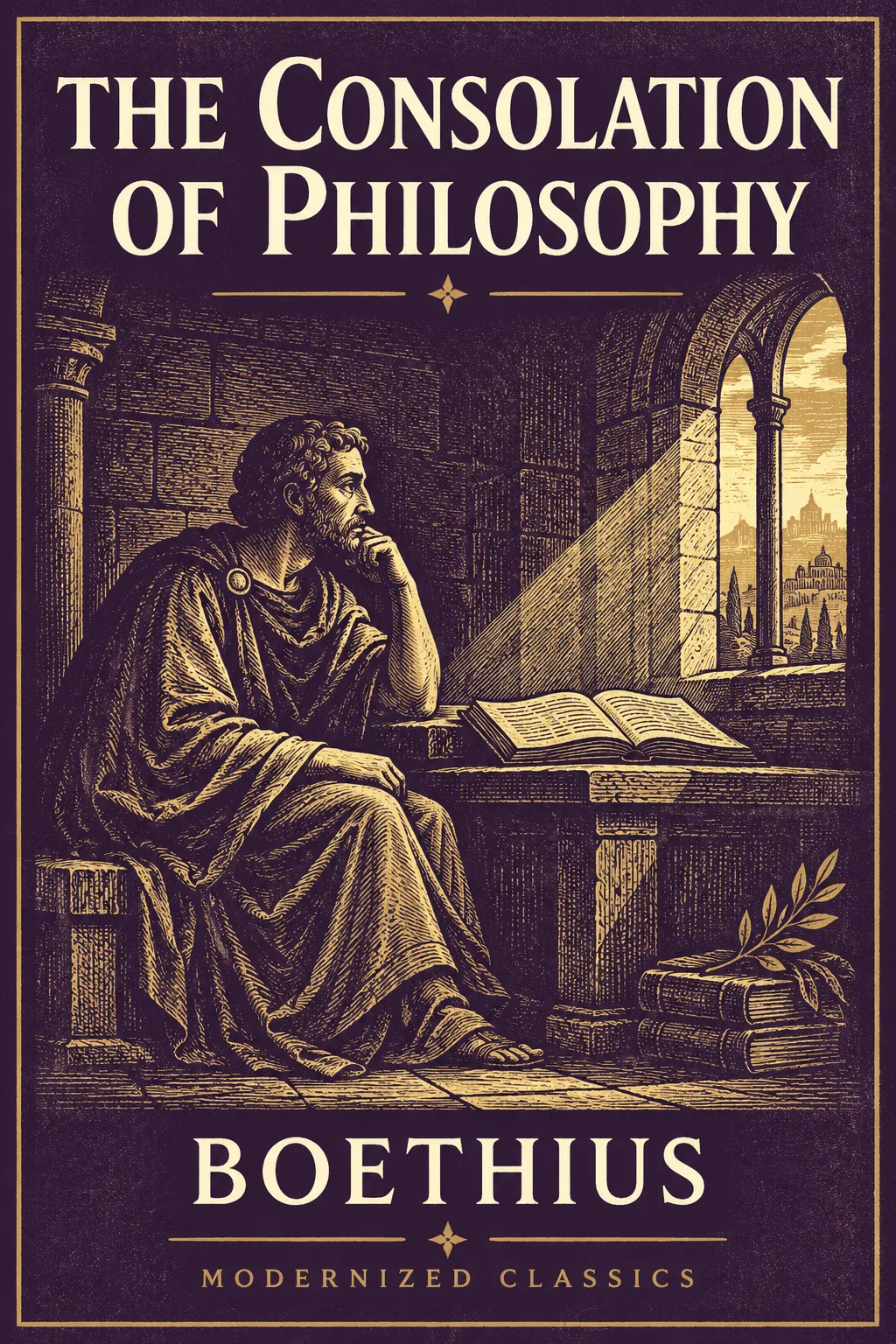
Book 1: The Sorrows of Boethius
SONG I. Boethius’ Complaint.
I, who once composed my studious verses
Smoothly in happier days,
Now am forced, in tears and sadness,
To learn to raise a mournful song.
See, the Muses, disheveled with grief,
Guide my pen and give voice to my sorrow;
Down their cheeks real tears
Flow along with my sad complaints!
These alone, in the hour of danger,
Proved faithful and dared to follow
In the footsteps of the exile
To his lonely journey’s end.
They, who were the pride and pleasure
Of my youth and high position,
Still remain the only comfort
In the old man’s mournful fate.
Old? Yes; swiftly, before I knew it,
Pressed on me by these sorrows,
Age has come; see, Grief has told me
To wear the clothing that suits her best.
Sprinkled on my head too early,
These white hairs announce my troubles,
And my skin hangs loose and shriveled
On this frame that sorrow has shrunk.
Blessed is the death that does not intrude
On the sweet, sweet years of peace,
But comes to the broken-hearted,
When they call, and brings release!
Yet Death passes by the wretched,
Shuts his ears and sleeps deeply;
He will not heed the cry of anguish,
Will not close the eyes that weep.
For while fickle Fortune still
Poured out her gifts and all was bright,
Death’s dark hour almost overwhelmed me
In the gloom of endless night.
Now, because misfortune’s shadow
Has clouded over that false face,
Cruel Life still stalls and lingers,
Though I hate his weary course.
Friends, why did you once so lightly
Boast that I was happy among men?
Surely one who has fallen like this
Was never standing firmly then.
I.
While I was silently thinking these things over and recording my sorrowful complaints with my pen, a woman seemed to appear above my head. Her face commanded deep reverence. Her eyes were bright as fire and more than humanly keen. Her complexion was fresh, and her strength showed no sign of weakening. Yet she was clearly very old, and she plainly did not seem to belong to our age and time.
Her height was hard to judge. At one moment she was no taller than an ordinary person; at another her forehead seemed to strike the sky. Whenever she raised her head higher, she began to reach into the heavens themselves, where the eyes of those looking at her could no longer follow.
Her clothes were made of an imperishable fabric, woven from the finest threads with the most delicate workmanship. As she later told me herself, she had woven them with her own hands. Age and neglect had somewhat dulled the beauty of this garment, giving it the grimy look that marble takes on when it is left exposed to the weather.
On the lowest edge was woven the Greek letter Π (P), and on the topmost edge the letter θ (Th). Between the two, steps could be seen, like a staircase leading from the lower letter to the upper one. This robe had also been torn by violent people, each of whom had snatched away whatever piece he could grab.
In her right hand she held a notebook, and in her left a staff. When she saw the Muses of Poetry standing by my bed, dictating the words of my lament, she grew angry for a moment, and her eyes flashed sternly.
‘Who,’ she said, ‘has let these theatrical temptresses come near this sick man? Far from giving him medicine to cure his illness, they feed it with sweet poison. They are the ones who kill the rich harvest of reason with the barren thorns of passion. They accustom people’s minds to their disease instead of setting them free.
‘If it were some ordinary man you were seducing with your charms, as you usually do, I would be less indignant. In such a man, none of my own work would have been undone. But this man was raised on the philosophies of the Eleatics and the Academy. No, go away, you Sirens, whose sweetness does not last! Leave him for my own Muses to care for and heal!’
At these reproaches, the whole group grew sadder still. With lowered eyes and blushes that confessed their shame, they left the room in sorrow.
My sight was dimmed from so much weeping, and I could not tell who this woman of such commanding authority was. I was stunned. Keeping my eyes fixed on the ground, I waited silently to see what she would do next.
Then she came closer and sat on the edge of my bed. Looking into my face, heavy with grief and turned sadly toward the ground, she lamented the disorder of my mind in these words:
SONG II. His Despondency.
Alas! Into what an abyss his mind
Has plunged, how wildly tossed!
Still, still toward the outer darkness
It sinks, its true light lost,
As often as, lashed into turmoil
By earthly winds, the waves of care rise high.
Yet once he roamed the open heavens,
Traced the sun’s bright pathway;
Watched how the cold moon waxed and waned;
And did not rest until there was missing
From his wide knowledge no star that steers
Amid the maze of circling spheres.
The causes why the blustering winds
Disturb the ocean’s calm face,
Whose hand turns the stable globe,
Or why, in his steady race,
Out of the ruddy east the sun
Runs down into the western waves:
What it is that skillfully moderates
The calm hours of spring,
So that it blossoms with the rose
To garland the earth;
Who loads the year’s riper season
With clustered grapes in autumn:
All this he knew, and always strove
To fathom Nature’s deep secrets.
Now, robbed of reason’s light, he lies here,
With chains weighing on his neck;
And, forced down by the heavy load,
His eyes are chained to this dull earth.
II.
‘But this is a time for healing,’ she said, ‘rather than for lamenting.’ Then, fixing her eyes directly on me, she cried: ‘Are you the man who was once fed on my milk and raised on the nourishment that only I can give, until you grew to the full strength of a mature spirit? I had given you armor that would have been an unbeatable defense, if you had not thrown it away first.
‘Do you know me? Why are you silent? Has shame or astonishment struck you dumb? I wish it were shame. But I can see that a stupor has taken hold of you.’
When she saw that I not only gave no answer but was mute and completely unable to speak, she gently laid her hand on my chest and said: ‘There is no danger. These are the symptoms of lethargy, the common sickness of deceived minds. He has forgotten himself for a while.
‘He will easily recover his memory, if only he first recognizes me. So that he can, let me now wipe his eyes, which are clouded by a mist of mortal things.’ With that, she used a fold of her robe to dry my eyes, which were swimming with tears.
SONG III. The Mists dispelled.
Then the darkness of night was scattered,
And sight returned to my eyes.
So, when the rainy northwest wind, Caurus,
Rolls the storm clouds through the skies,
The sun is hidden; all the heavens
Are darkened in starless night.
But if Boreas, the north wind, sweeping in with a wild charge,
Frees the imprisoned light of day,
Suddenly the radiant god streams out
And strikes our dazzled eyes with his beams.
III.
In the same way, the clouds of my melancholy broke apart. I saw the clear sky and regained the ability to recognize my physician’s face. So when I lifted my eyes and fixed my gaze on her, I saw my nurse, Philosophy, whose halls I had frequented since my youth.
‘Ah!’ I cried. ‘Mistress of all excellence, why have you come down from on high into the solitude of my exile? Is it so that you, too, like me, may be persecuted with false accusations?’
‘Could I abandon you, my child,’ she said, ‘and not lighten the burden you have taken on because people hate my name, by sharing this trouble with you? Even setting aside that it would be wrong for Philosophy to leave the path of the innocent without company, do you think I would fear being criticized? Would I shrink from it as though something strange and new had happened?
‘Do you think this is the first time, in an evil age, that Wisdom has been put in danger? Long ago, before my servant Plato lived, did I not often fight hard battles against the recklessness of folly? And in Plato’s own lifetime, his teacher Socrates, with my help, won the victory of an unjust death.
‘Afterward, one after another, the Epicurean herd, the Stoics, and the rest each did all they could to seize the inheritance Socrates left. They dragged me off as their plunder while I protested and resisted. They tore apart the garment I had woven with my own hands, and, clutching the torn scraps, went away believing that all of me had become theirs.
‘Some of them, because traces of my clothing could be seen on them, were destroyed through the error of the ignorant crowd, who wrongly believed them to be my disciples.
‘You may not know about the banishment of Anaxagoras, the poison Socrates drank, or the torture of Zeno, since these things happened in a distant country. But you could have learned the fate of Arrius, of Seneca, and of Soranus, whose stories are neither old nor obscure.
‘These men were destroyed for no other reason than this: grounded as they were in my principles, their lives stood in obvious contrast to the ways of the wicked.
‘So you should not be surprised if we are tossed by storms on the sea of this life, since our chief aim has been to refuse to go along with wrongdoers. The army of the wicked may be large, but it deserves contempt. It has no leadership and is driven this way and that by the blind force of mad error.
‘And if at times they line up against us and attack in overwhelming strength, our leader withdraws her forces into the citadel while they are busy looting the worthless baggage. From our high ground, safe from all this frenzy, we laugh to see them seizing the most worthless things as prizes. We are protected by a fortress that aggressive folly can never hope to reach.’
SONG IV. Nothing can subdue Virtue.
Whoever, calm, serene, composed,
Sets his foot on haughty fate;
Firm and steadfast, come what may,
Keeps his bearing still unconquered:
Him the rage of furious seas,
Tossing high their wild threats,
Nor the flames from smoky forges
That Vesuvius spews out,
Nor the lightning bolt that from the sky
Strikes the tower, can terrify.
Why, then, should you feel afraid
Of a tyrant’s feeble power?
Do not dread him, fear no harm,
And you will disarm his rage;
But whoever gives way to hope or fear,
Having lost control of his own heart,
Has thrown away his shield,
Fled the field like a coward;
He has forged, all unaware,
Chains his own neck must bear!
IV.
“Do you understand?” she asks. “Are my words sinking into your mind? Or are you as dull to them ‘as a donkey to the sound of the lyre’? Why are you weeping? Why are tears streaming from your eyes?
“‘Speak out; do not hide it in your heart.’
“If you want the physician’s help, you must show him your wound.”
Then I gathered what strength I could and began. “Is there still any need to tell you? Isn’t the cruelty of Fortune toward me obvious enough? Doesn’t the very appearance of this place move you?
“Is this the library, the room you chose as your regular retreat in my home? Is this where we so often sat together and discussed everything in heaven and on earth? Did I look and dress like this when I explored nature’s hidden secrets with you? Back then you traced the paths of the stars for me with your rod. All the while, you shaped my character and my whole way of life on the pattern of the heavenly order. Is this the reward for my obedience?
“Yet you yourself, speaking through Plato, laid down the principle that ‘states would be happy if either philosophers ruled them, or their rulers happened to become philosophers.’ Through Plato you also gave the pressing reason why philosophers must enter public life. If the reins of government are left to unprincipled and corrupt citizens, trouble and ruin will fall upon the good.
“Following this teaching, I tried to apply in public administration the principles I had learned from you in quiet, leisured seclusion. You are my witness, along with the divinity who planted you in the hearts of the wise, that I brought nothing to my duties except devotion to the public good.
“That is why I became caught up in bitter feuds that could never be reconciled. And as inevitably happens when a man keeps his conscience independent, I had to accept giving offense to the powerful for the sake of justice.
“How often did I confront Conigastus and block his attacks on the fortunes of the weak? How often did I thwart Trigguilla, the steward of the king’s household, even when his wicked schemes were all but accomplished? How often did I risk my position and influence to protect poor wretches from the countless false charges with which the greed and lawlessness of the barbarians constantly harassed them? No one ever drew me away from justice toward oppression.
“When the provincials were being ruined by the combined pressure of private plunder and public taxation, I grieved no less than those who suffered. In a time of severe scarcity, a forced sale of grain was proclaimed. It was as disastrous as it was unjustifiable, and it threatened to starve Campania.
“For the public’s sake I took up the fight against the praetorian prefect. I argued the case before the king’s judgment seat, and I succeeded in stopping the sale from being enforced.
“I rescued Paulinus, a former consul, from the gaping jaws of the palace bloodhounds, who in their greedy expectations had already as good as devoured his wealth. Albinus, a man of the same high rank, faced penalties on a charge decided before it was heard. To save him, I exposed myself to the hatred of Cyprian the informer.
“Do you think I had piled up enough enemies for myself? Well, at least among the rest of my fellow citizens my safety should have been secure, since my love of justice had left me no hope of security at court. Yet who brought the charges that struck me down? One of my accusers is Basil. He had been dismissed from the king’s household, and his debts drove him to inform against me.
“Then there are Opilio and Gaudentius. For many different offenses the king had sentenced them to banishment. They refused to obey and tried to save themselves by taking sanctuary. As soon as the king heard of it, he decreed that if they did not leave the city of Ravenna by a set deadline, they would be branded on the forehead and driven out. What could exceed the harshness of that sentence?
“And yet on that same day these very men lodged information against me, and their information was accepted. Just Heaven! Had my way of life earned me this? Did the fact that my condemnation was already decided make them fit accusers? Has Fortune no shame? If she is not ashamed that an innocent man is accused, is she not at least ashamed at how vile the accusers are?
“Perhaps you wonder what the charges against me amount to. They say I wished to save the senate. But how? I am accused of preventing an informer from producing evidence that would prove the senate guilty of treason.
“So tell me, my mistress, what do you advise? Shall I deny the charge, so as not to bring shame on you? But I did wish it, and I will never stop wishing it. Shall I admit it? Then my work of blocking the informer will be at an end.
“Shall I call the wish to preserve that illustrious body a crime? Indeed, the senate itself has made it one by its decrees against me! But blind folly, though it may deceive itself with false names, cannot change the true worth of things. Remembering Socrates’ rule, I do not think it right either to hide the truth or to let a falsehood stand.
“However that may be, I leave it to your judgment and to the verdict of those with discernment. And so that the course of events and the real facts will not be hidden from future generations, I have written down an account of the whole affair myself.
“What need is there to mention the forged letters meant to prove that I hoped for Rome’s freedom? Their falseness would have been obvious if I had been allowed to use the informers’ own confession, the kind of evidence that carries the most weight in every matter. And really, what hope of freedom is left to us? I wish there were some!
“If there were, I would have answered with the retort of Canius. When Caligula declared that Canius had known about a conspiracy against him, Canius replied: ‘If I had known, you would never have known.’
“Grief has not dulled my perception so much that I complain because wicked men plot crimes against the virtuous. What amazes me is that they achieve what they hope for. Evil intentions may perhaps come from the imperfection of human nature. But that scoundrels can carry out their worst schemes against the innocent while God looks on is truly monstrous.
“Not without reason, then, one of your followers asked: ‘If God exists, where does evil come from? Yet where does good come from, if He does not exist?’
“Still, it may well be that wretches who seek the blood of all honest men and of the whole senate should also want to destroy me. They saw me as a bulwark defending the senate and all honest men. But did I deserve such a fate from the senators too?
“You remember, I think, since you always stood beside me to direct what I should do or say. You remember what happened at Verona. The king, eager for a general destruction, was determined to implicate the entire senatorial order in the treason charge against Albinus. With no concern for my own danger, I defended the innocence of its members, every one of them.
“You know that what I say is true, and that I have never boasted of my good deeds out of self-praise. Whenever a man advertises his good deeds and is repaid with fame, he reduces to some degree the secret reward of a good conscience.
“You see what has become of my innocence. Instead of reaping the rewards of true virtue, I suffer the penalties of a guilt falsely charged against me. And worse than that: even an open confession of guilt has never made the judges so unanimously harsh. In such cases, some thought of mere human frailty, or of Fortune’s universal instability, has always softened the verdict of at least a few.
“If I had been accused of planning to burn the temples, of slaughtering the priests with an impious sword, or of plotting the massacre of all honest men, I would still have been brought into court. I would have been punished only after confessing or being convicted.
“Instead, for my excessive zeal on behalf of the senate, I have been condemned to outlawry and death, unheard and undefended, nearly five hundred miles away. Oh, my judges, you well deserve that no one should ever again be convicted of a fault like mine!
“Even my accusers saw how honorable the charge against me was. To cover it with some appearance of guilt, they falsely claimed that in pursuit of my ambition I had stained my conscience with sacrilegious acts. But your spirit, living within me, had driven every craving for earthly success out of my soul. With your eye always on me, there was no room left for sacrilege.
“Every day you repeated in my ear and planted in my mind the Pythagorean maxim, ‘Follow God.’ It was hardly likely, then, that I would seek the help of the vilest spirits while you were shaping me toward an excellence that would make me like God.
“Besides, the purity of my private household protects me from even the suspicion of sacrilege. So do my friends of the highest integrity, and my father-in-law, who is revered both for his blameless character and for his active generosity.
“Yet, outrageous as it is, they even draw support for this charge from you. I am likely to be thought involved in wickedness for this very reason: that I am steeped in your teachings and established in your ways. So it is not enough that my devotion to you has gained me nothing. You too must be attacked because of the hatred I have brought upon myself.
“This is truly the crowning misfortune. Most people judge not by real merit but by outcomes. They recognize foresight only where Fortune has rewarded the result with her approval. As a result, reputation is the first thing to abandon the unfortunate.
“I remember with bitterness how perverse public opinion is, how varied and conflicting people’s judgments are. I will say only this: the most crushing burden of misfortune is that once a charge is pinned on the unhappy, everyone believes they deserved their suffering. As for me, I have been banished from all of life’s blessings, stripped of my honors, and stained in reputation. I am being punished for doing good.
“And now I think I see the vile dens of the wicked surging with joy and celebration. The most reckless and unscrupulous are threatening a fresh crop of lying accusations. The good lie flattened with terror at my danger. Every thug is spurred to new daring because he goes unpunished, and to success by the profits his boldness brings.
“The innocent are robbed not only of their peace of mind but of every means of defense. That is why I long to cry out:
SONG V. Boethius’ Prayer.
“Builder of that starry dome,
You who, throned forever, whirl
Heaven’s swift globe, and as they roam
Guide the stars by laws on high:
So, in full-orbed splendor dressed,
Cynthia, the Moon, dims the lamps of night,
But drawn closer to her brother Sun,
Loses all her light.
“The star that, as the evening falls,
Shows its cold radiance as Hesper,
As Lucifer then hides its beams,
Paling as the sunlight grows.
Brief, while winter’s frost holds sway,
By your will, is the span of day;
Swift, when summer’s heat is glowing,
The hours of night speed away.
“You rule the changing year:
When rough Boreas bears down,
The leaves fall; they reappear,
Coaxed back by Zephyr’s soft caress.
Fields that Sirius scorches, thick with grain,
Were sown while Arcturus kept watch:
Each thing acknowledges the reign of law,
And keeps the place that is its own.
“Sovereign Ruler, Lord of all!
Can it be that You scorn
Only man? Against him, poor slave,
Wanton Fortune plays her emptiest games.
The punishment that guilt deserves
Falls upon the innocent;
Raised on high, the most profane
Vent their malice on the just.
“Virtue cowers in dark hiding places,
The righteous bear the foul stain of crime,
Perjury and false deceit
Do no harm to the one who dares the wrong;
But whenever the wicked trust
In evil strength to work their will,
Kings whom nations hold in awe
As mighty grovel in the dust.
“Look, oh look upon this earth,
You who on law’s sure foundation
Framed all things! Have we no worth,
We poor men, of all creation?
Hard we toss on Fortune’s tide;
Master, bid the waves subside!
And bring earth’s ways to the completion
Of Your heaven’s order, and guide them!”
V.
When I had poured out my griefs in this long, unbroken lament, she remained calm. My complaints did not disturb her in the least, and she spoke to me as follows:
‘When I saw you sorrowful and in tears, I knew at once that you were miserable and an exile. But I would not have known how far your exile had taken you if your own words had not revealed it.
‘Yet how far you are from your homeland! You have not been banished. You have wandered away. Or, if you insist on calling it banishment, then you have banished yourself. No one else could ever have lawfully held such power over you.
‘Remember the country you come from. It is not ruled, as Athens once was, by the sovereignty of the crowd. Instead, “one is its Ruler, one its King.” This Ruler delights in the number of His citizens, not in sending them into exile. To submit to His government and to obey His laws is perfect freedom.
‘Do you not know the most ancient law of your country? It decrees that no one who has chosen to make his home there may ever be sent into exile. There is no danger that anyone sheltered within its walls and defenses should deserve exile. But whoever stops wishing to live there also stops deserving to live there.
‘So it is not so much the appearance of this place that troubles me as your appearance. What I miss is not your library, with its walls adorned with glass and ivory, but the chamber of your mind. There I once placed, not books, but what gives books their value: the teachings my books contain.
‘What you have said about your services to the public good is true, though it falls short of how much you actually deserve. The charges brought against you, which you mentioned, are publicly known, whether they are to your credit or simply false.
‘As for the crimes and deceptions of the informers, you were right to pass over them lightly. Public opinion has already judged them better and more fully than you could.
‘You complained bitterly about the injustice of the Senate. You grieved that I myself have been slandered, and you lamented the damage to my good name. Finally, your anger blazed out against Fortune, and you complained that your merits had been unfairly rewarded. Last of all, your frantic Muse composed a prayer that the peace that rules in heaven might rule the earth as well.
‘But a crowd of turbulent passions has assailed your soul. You are torn apart by anger, pain, and grief. In this present mood, strong remedies are not right for you.
‘So for a while I will use gentler methods. The swellings that have hardened under this flood of disturbing passion must first be softened by mild treatment, until they can bear the force of sharper cures.’
SONG VI. All Things have their Needful Order.
Whoever trusts the stubborn furrows
With his generous grain
When the Crab with deadly fever
Scorches all the plain,
Will find his granary stripped bare,
With acorns for his meager fare.
Do not go to gather violets
From the purple hillside steep
While the furious winds of winter
Through the valleys sweep;
Nor rush the grapes too soon to bring
To the winepress in the spring.
For to each thing God has given
Its appointed time;
He permits no confusing changes
In His plan sublime.
So whoever breaks the order set
Will meet an outcome to regret.
VI.
‘First, then, will you let me ask you a few questions to test the state of your mind? Then I will know how to go about curing you.’
‘Ask whatever you like,’ I said. ‘I will answer any question you choose to put to me.’
Then she said: ‘This world of ours—do you think it is governed by random chance, or do you believe there is some rational guidance in it?’
‘I could never think,’ I said, ‘that motions so regular could be determined by random chance. I know that God the Creator presides over His work. The day will never come that drives me from holding firmly to the truth of this belief.’
‘Yes,’ she said. ‘You even affirmed it in your song just now, when you lamented that human beings alone had no share in God’s care. You did not doubt that everything else was ruled by reason. Yet I am deeply puzzled how you could have fallen ill while holding so firmly to this belief.
‘But let us probe more deeply. Something is missing, I think. Now tell me: since you do not doubt that God governs the world, do you see by what means He rules it?’
‘I hardly understand what you mean,’ I said, ‘let alone how to answer your question.’
‘Was I not right to say that something was missing? Through that gap, as through a breach in a city’s walls, disease has crept in to disturb your mind. But tell me, do you remember the universal goal toward which all of nature is directed?’
‘I once heard it,’ I said, ‘but grief has dulled my memory.’
‘And yet you know where all things came from.’
‘Yes, I know that,’ I said, ‘and I have answered that they come from God.’
‘Then how is it possible that you do not know the purpose of existence, when you understand its source and origin? Still, disturbances of mind like these can shake a person’s footing. They cannot pull him up and uproot him from himself entirely. But answer this too, please: do you remember that you are a human being?’
‘How could I not?’ I said.
‘Then can you tell me what a human being is?’
‘Is this your question: whether I know myself to be a rational and mortal creature? Certainly I acknowledge that I am such a being.’
Then she asked: ‘Do you know nothing else that you are?’
‘Nothing.’
‘Now,’ she said, ‘I know another cause of your illness, and a serious one. You have stopped knowing your own nature. So I have fully discovered both the causes of your sickness and the means of restoring your health.
‘Because you have forgotten yourself, your mind is bewildered. That is why you have mourned as an exile, as a man stripped of the good things that were his. Because you do not know the purpose of existence, you believe that vile and wicked people are happy and powerful.
‘And because you have forgotten by what means the world is governed, you think that the changes of fortune ebb and flow with no guiding hand to restrain them.
‘These errors are serious enough to cause not just sickness but even death. But thanks be to the Author of our health, the light of nature has not yet left you entirely.
‘You judge truly about the government of the world. You believe it is subject not to the random drift of chance but to divine reason. That belief is the divine spark from which we may hope for your recovery.
‘So have no fear. From these weak embers the warmth of life will be kindled in you once again. But it is not yet time for strong remedies. The mind is clearly made in such a way that whenever it throws off true opinions, it immediately takes on false ones. From these false opinions rises a cloud of confusion that disturbs its true vision.
‘So I will now try to scatter these mists with mild and soothing treatment. Then the darkness of misleading passion may be dispersed, and you may come to see the splendor of the true light.’
SONG VII. The Perturbations of Passion.
Stars give no light
Through the black night
When the clouds hide;
And the lashed wave,
When the winds rave
Over ocean’s tide—
Though once serene
As day’s bright sheen—
Soon fouled and spoiled
By the storm’s spite,
Shows to the sight
Muddy and soiled.
Often the clear stream,
Down the steep hill
Wandering seaward,
Some tumbled block
Of fallen rock
Halts and holds still.
Do you, then, long
Clearly and plainly
Truth to discern,
On the right road
Firmly to stay,
And never to turn?
Let joy, hope, and fear
Never come near;
Drive grief away:
Shackled and blind
And lost is the mind
Where these hold sway.
Book 2: The Vanity of Fortune’s Gifts
I.
Then for a while she was silent. When a short pause in her speaking had restored my flagging attention, she began:
‘If I have fully understood the nature and causes of your sickness, you are wasting away with regretful longing for your former fortune. You believe that the change in this fortune is what has so disturbed your mind.
‘I understand very well the many tricks of that Siren. I know the deadly charm of the friendship she pretends to feel for her victims while she is scheming to trap them. And I know how she abandons them without warning and leaves them overwhelmed with unbearable grief.
‘Consider her nature, her character, and what she deserves, and you will soon admit that in her you neither possessed nor lost anything of value. I do not think I need to work hard to remind you of this. Even when she was still with you, even while she was flattering you, you used to attack her in strong, manly terms and rebuke her with maxims drawn from my sacred treasury.
‘But every sudden change of circumstances inevitably unsettles the spirit. That is how you, too, have lost your mind’s calm for a while. It is time now for you to take and drink a mild, pleasant-tasting medicine. As it works its way inward, it can prepare the way for stronger remedies.
‘So I call to my aid the sweet persuasion of Rhetoric, who walks the right path only when she does not abandon my teaching. And I tell Music, my servant, to join her in song, sometimes in a lighter key, sometimes in a graver one.
‘What is it, then, poor mortal, that has thrown you into lament and mourning? I suppose your eyes have seen something strange and unfamiliar. You think Fortune has changed toward you. You are mistaken. These were always her ways; this was always her nature. In her very changeability she has kept her true constancy toward you.
‘She was exactly the same when she showered you with affection and deceived you with the attractions of a false happiness. You have discovered how changeable the face of the blind goddess is. She still hides herself from others, but she has revealed her whole character to you.
‘If you like her, take her as she is and do not complain. If you hate her treachery, turn away from her in contempt and give her up, for her illusions do harm. The very thing that now causes your great grief should have brought you peace. You have been abandoned by someone whom no one can trust not to abandon him.
‘Or do you really value a happiness that is certain to leave? I ask again: is Fortune’s presence dear to you when she cannot be trusted to stay, and when she will bring sorrow once she is gone? If she cannot be kept at will, and if her departure overwhelms you with disaster, what is this passing visitor but a sign of trouble to come?
‘It is not enough to look only at what lies in front of your eyes. Wisdom measures how things will turn out. Fortune’s changeability has two sides, and that very changeability makes her threats nothing to fear and her flattery little to be desired.
‘Finally, once you have placed your neck under her yoke, you ought to accept whatever happens within the borders of Fortune’s territory. You freely chose her as your mistress. If you now want to impose on her a rule about when she must stay and when she may go, are you not acting wrongly? Are you not making a lot you cannot change more bitter through your impatience?
‘If you trusted your sails to the winds, you would travel not where you meant to go but where the winds drove you. If you trusted your seed to the fields, you would weigh the fruitful years against the barren ones. You have given yourself over to Fortune’s rule, so you must submit to your mistress’s whims.
‘What! Are you really trying to stop the turning wheel from spinning? You most foolish of mortals—if it stands still, it is no longer the wheel of Fortune.’
SONG I. Fortune’s Malice.
Mad Fortune sweeps along in reckless pride,
As restless as Euripus’ surging tide;
Now tramples mighty kings beneath her feet,
Now sets the conquered in the victor’s seat.
She takes no notice of the cries of woe,
But mocks the griefs that from her mischief flow.
This is her game; this way she shows her power;
And great the wonder when, in one brief hour,
She shows her favorite lifted high in bliss,
Then hurled headlong in misery’s abyss.
II.
‘Now I would also like to reason with you a little in Fortune’s own words. Notice whether her arguments are fair.
‘“Man,” she might say, “why do you chase me with your daily complaints? What wrong have I done you? What goods of yours have I taken? Choose a judge, if you like, and let us argue before him about who rightfully owns wealth and rank. If you can show that any one of these things truly belongs to mortal man, I will freely grant that what you claim is yours.
‘“When nature brought you out of your mother’s womb, I took you in, naked and with nothing. I nourished you from my own resources. Because I favored you, I raised you somewhat too indulgently, and that is what now makes you rebel against me. I surrounded you with a royal abundance of everything in my power.
‘“Now it pleases me to withdraw my hand. You have reason to thank me for the use of what was never yours. You have no right to complain as if you had lost what was entirely your own. Why, then, do you lament? I have done you no violence.
‘“Wealth, honor, and all such things are under my control. My servants know their mistress: they come with me and leave when I go. I could boldly claim that if the things whose loss you mourn had really been yours, you could never have lost them. Am I alone to be forbidden to do as I wish with what is mine?
‘“No one rebukes the sky when it now shows the brightness of day and now covers the daylight in the darkness of night. The year may now crown the face of the earth with flowers and fruit, and now spoil it with storms and cold. The sea is allowed to invite you today with a smooth, calm surface and tomorrow to turn rough with waves and storm.
‘“Shall man’s endless greed bind me to a constancy that is foreign to my nature? This is my art; this is the game I never stop playing. I turn the spinning wheel. I enjoy seeing the high come down and the low rise up. Climb, if you wish, but only on condition that you will not consider it unfair to come down when the rules of my game require it.
‘“Did you not know my character? Did you not know how Croesus, King of the Lydians, once the feared rival of Cyrus, was later pitiably placed on the flames of a pyre and saved only by a shower sent from heaven? Have you missed how Paullus shed tears of sincere pity over the misfortunes of King Perseus, his prisoner?
‘“What else do tragedies cry out over so mournfully, except the overthrow of kingdoms by Fortune’s indiscriminate blows? Did you not learn as a child that at the threshold of Zeus stand ‘two jars,’ ‘one full of blessings, the other of calamities’?
‘“What if you have drawn too generously from the good jar? What if I have not even now left you entirely? What if my very changeability is a fair reason to hope for better things?
‘“But listen now. Stop letting your heart waste away in fretting, and do not expect to live on your own terms in a realm that belongs to everyone.”’
SONG II. Man’s Covetousness.
What though Plenty pours her gifts
With a lavish hand,
Numberless as are the stars,
Countless as the sand,
Will the human race, content,
Cease to grumble and lament?
No—though God, so generous, gives
Gold at man’s desire—
Honors, rank, and fame—content
Comes not any nearer;
But an all-devouring greed
Gapes with ever-widening need.
Then what limits can restrain
This wild lust for having,
When, with each new bounty fed,
Grows the frantic craving?
He is never rich whose fear
Sees grim Want forever near.
III.
‘If Fortune pleaded with you in this way, you would surely have not a single word to say in reply. Or, if you can find some justification for your complaints, you must show what it is. I will give you room to speak.’
Then I said: ‘Your arguments are certainly persuasive. They are soaked in the honeyed sweetness of music and rhetoric. But their charm lasts only while they are sounding in the ear. The wretched feel their misfortunes at a deeper level, in the heart. So when the sound stops vibrating in the air, the sorrow living in the heart returns with fresh bitterness.’
Then she said: ‘It is just as you say, for we have not yet reached the cure of your sickness. So far these are only soothing remedies that help in treating an illness that has been stubborn until now. I will apply the remedies that go deep at the proper time.
‘Still, to argue against your determination to be considered wretched, I ask you: have you forgotten the extent and limits of your happiness? I say nothing of how, when you were orphaned and alone, you were taken into the care of distinguished men.
‘Nor do I dwell on how you were chosen for alliance by marriage with the highest in the state. Even before you were joined to their house, you were already dear to their love, which is the most precious of all bonds. Did not everyone call you most happy because of your wife’s virtues, her father’s splendid honors, and the blessing of sons?
‘I pass over the distinctions, often denied to older men, that you enjoyed in your youth, since I do not care to speak of blessings that others have also shared. I prefer to come to the unmatched peak of your good fortune. If the enjoyment of any earthly success carries weight in the scale of happiness, can any rising flood of troubles sweep away the memory of that splendor?
‘Remember that day when you saw your two sons ride out from home as joint consuls, followed by a procession of senators and welcomed by the goodwill of the people. The two of them sat in the curule chairs in the Senate-house, and your speech in praise of the king earned you fame for eloquence and ability.
‘In the Circus you sat between the two consuls and satisfied the crowd pressing around you with the triumphal gifts they expected. On that day, I think, you outwitted Fortune while she was flattering you and making you her darling. You carried off a gift she had never before granted to any private person.
‘Do you, then, want to settle accounts with Fortune? This is the first time she has cast a jealous glance at you. If you compare the extent and limits of your blessings and your misfortunes, you cannot deny that you are still fortunate.
‘Or, if you do not consider yourself favored by Fortune because your former apparent prosperity has gone, do not consider yourself wretched either. What you now believe to be disaster is also passing away.
‘What! Have you only now arrived on the stage of this life, suddenly and as a stranger? Do you think there is any stability in human affairs, when man himself vanishes in the swift course of time? It is true that we can have little confidence that the gifts of chance will last. Yet the last day of life is, in a way, the death of whatever Fortune remains.
‘What difference, then, do you think it makes whether you leave her by dying or she leaves you by running away?’
SONG III. All passes.
When, in rosy chariot drawn,
Phoebus starts to light the dawn,
By his flaming beams assailed,
Every glimmering star grows pale.
When the grove, by Zephyrs fed,
With rose-blossom blushes red—
Once harsh Auster’s breath has blown,
Bare it stands, its glory flown.
Smooth and tranquil lies the deep
While the winds are hushed in sleep.
Soon, when angry tempests lash,
Wild and high the billows crash.
So, if Nature’s changing face
Holds not still a moment’s space,
Count man’s fortunes fleeting; deem
Bliss as passing as a dream.
One law only stands fast:
Things created cannot last.
IV.
Then I said: ‘Your warnings are true, you who nurture every excellence. I cannot deny how remarkably fast my fortune rose. Yet that is exactly what hurts me more cruelly when I remember it. For in bad fortune, the worst sting of misery is to have been happy.’
‘Well,’ she said, ‘if you are paying the penalty for a mistaken belief, you cannot fairly blame your circumstances for it. If what moves you is the happiness Fortune gives, though it is happiness in name only, then come and count up with me how rich you are in the number and weight of your blessings.
‘Suppose that, by the blessing of Providence, you still keep safe and untouched the very thing you would have considered your most precious possession, however you valued the rest of your fortune. Then what right do you have to talk about bad fortune while you keep all of Fortune’s better gifts?
‘Symmachus, your wife’s father, is safe and unharmed. He is a man whose splendid character does honor to the human race. This rare nature, in whom wisdom and virtue are so nobly combined, mourns the wrongs done to you while he himself is out of danger. You would have gladly bought his safety at the price of your own life.
‘Your wife is still alive. She has a gentle disposition and unequaled modesty and virtue. The sum of all her graces is this: she is her father’s true daughter. She lives, I say, and keeps breathing only for your sake, though she hates life itself. She wastes away in grief and tears because you are gone. In this, if in nothing else, I would admit that your happiness is somewhat spoiled.
‘What shall I say of your sons and their rank as consuls? In them, as far as is possible in young men their age, the example of their father’s and grandfather’s character already shines out.
‘The chief concern of mortals is to preserve their life. How happy you are, then, if only you could recognize your blessings! Even now you possess what no one doubts is dearer than life. So dry your tears.
‘Fortune’s hatred has not reached all those you love. The storm that has struck you is not unbearably severe, because some anchors are still holding firm. They ensure that you lack neither comfort in the present nor hope for the future.’
‘I pray that they keep holding. As long as they remain, I will ride out the storm, whatever happens. Yet you see how much of the splendor of my fortunes has been cut away.’
‘We are gaining a little ground,’ she said, ‘if there is something in your situation that you are not yet entirely unhappy with. But I cannot tolerate your fussiness. You complain with such violent grief and anxiety simply because your happiness falls short of being complete.
‘Who enjoys such settled happiness that he has no quarrel with some part of his situation? The conditions of human happiness are a troubled business. Either they are never fully achieved, or they never last.
‘One man has great riches but is ashamed of his low birth. Another is distinguished by noble birth but is so troubled by poverty that he would prefer to be unknown. A third, well supplied with both, laments the loneliness of an unmarried life. Another is happily married but has no children, and he builds up his wealth for a stranger to inherit. Yet another has children but sadly laments the misdeeds of a son or daughter.
‘So it is not easy for anyone to be completely at peace with his situation. Every person’s lot hides something that people who have not experienced it know nothing about, but that makes the one who suffers it wince.
‘Besides, the more Fortune favors a man, the more delicately sensitive he becomes. Unless everything goes as he wishes, the smallest misfortunes overwhelm him, because he has had no training in adversity. That is how petty the trifles are that rob the most fortunate people of perfect happiness!
‘How many people do you suppose would think themselves close to heaven if even a small part of what is left from the wreck of your fortune fell to them? This very place you call exile is home to the people who live here.
‘So true is it that nothing is wretched unless you think it so. And on the other hand, every situation is happy if it is borne with a calm mind. Who is so blessed by Fortune that he would not want to change his condition, once he gives free rein to a rebellious spirit?
‘How much bitterness is mixed in with the sweetness of human happiness! And even if that sweetness seems delightful while one enjoys it, no one can stop it from leaving whenever it pleases. How plainly wretched, then, is the happiness of earthly fortune. It does not last forever even for those with a calm temperament, and it can give no complete satisfaction to the anxious.
‘Why, then, you children of mortality, do you look outside yourselves for a happiness whose home is only within you? Error and ignorance confuse you. I will show you briefly the hinge on which perfect happiness turns.
‘Is there anything more precious to you than yourself? Nothing, you will say. If, then, you are master of yourself, you will possess something you will never want to lose, and which Fortune cannot take from you.
‘Now consider why happiness cannot possibly consist in these things that are the playthings of chance. Happiness is the highest good of a creature that lives according to reason. Anything that can be taken away in any way is not the highest good, because whatever cannot be taken away is better than it. So it is clear that Fortune, because it is unstable, cannot hope to give happiness.
‘Besides, a man carried along by this passing happiness either knows that it is unstable or does not know. If he does not know, how poor is a happiness that depends on blind ignorance! If he does know, he must fear losing a happiness that he believes he can lose. So constant fear prevents him from being happy.
‘Or does he think the possibility of this loss is a small matter? Then the good whose loss he can bear so calmly must be insignificant.
‘Further, I know that you firmly believe that human souls do not die with their bodies, and that many proofs have convinced you of this. It is also clear that the happiness Fortune gives ends with the death of the body. So there can be no doubt: if happiness came in this way, the whole human race would sink into misery when death brought everything to an end.
‘But we know that many people have sought the joy of happiness not only through death, but also through pain and suffering. How, then, can this life make people happy by its presence, when its loss does not make them wretched?’
SONG IV. The Golden Mean.
Whoever, founded firm and sure,
Would always live secure,
In spite of storm and blast
Unmoved and holding fast;
Whoever would laugh to scorn
The ocean’s threatening tide—
Should never build his home
On sands or mountain peak.
Upon the mountain’s height
The storm winds vent their spite;
The shifting sands refuse
To hold the weight they bear.
So flee these dangers, you,
However fair the view,
And set your resting place
On some low rock’s sure base.
Then, though the tempests roar,
And seas thunder on the shore,
You, blessed in your stronghold,
Will rest undisturbed;
Live all your days serene,
And mock the anger of the heavens.
V.
‘But since my arguments are beginning to soothe your mind, I think I may use somewhat stronger remedies. Suppose, then, that the gifts of Fortune were not fleeting and temporary. What is there in them that could ever truly become yours? And what in them does not lose value when looked at steadily and weighed fairly?
‘Are riches precious, I ask you, because of your nature or because of their own? What are they but mere gold and piles of money? Yet these fine things show their quality better when they are spent than when they are hoarded. For I suppose it is plain that greed always makes people hated, while generosity brings fame.
‘But what is transferred to another cannot remain in one’s own possession. If that is so, money is precious only when it is given away. And by being transferred to others, it stops being one’s own.
‘Again, if all the money in the world were piled up in one man’s possession, everyone else would be made poor. Sound fills the ears of many people at the same time without being broken into parts. But your riches cannot pass to many people without being reduced in the process. When this happens, they must impoverish those they leave behind.
‘How poor and cramped a thing riches are, then! More than one person cannot possess them whole and undivided, and they do not come to any one person without impoverishing everyone else.
‘Or is it the glitter of gems that attracts your eye? However rare and excellent their brilliance may be, remember that the flashing light is in the jewels, not in the man. Indeed, I am greatly amazed that people admire them. What can rightly seem beautiful to a being gifted with life and reason, if it lacks the movement and structure of life?
‘It is true that such things do eventually gain some beauty from their Maker’s care and from their own brilliance. Even so, they do not in any way deserve your admiration, because their excellence ranks lower than your own.
‘Does the beauty of the fields delight you? Certainly it does. It is a beautiful part of a truly beautiful whole. It is right for us at times to enjoy the calm stillness of the sea, and to admire the sky, the stars, the moon, and the sun. Yet does any of these belong to you? Do you dare to boast of the beauty of any one of them?
‘Are you adorned with the flowers of spring? Is it your fertility that swells in the fruits of autumn? Why are you stirred by empty excitement? Why do you embrace an excellence that belongs to something else as though it were your own? Fortune will never make yours what the nature of things has excluded from your ownership.
‘No doubt the fruits of the earth are given to feed living creatures. But if you are content to supply your needs as far as nature requires, you have no need to turn to Fortune’s generosity. Nature is satisfied with few things, and with very little of those. If you try to force extras on her when she is already satisfied, what you add will turn out either unpleasant or harmful.
‘Now, you think it fine to shine in clothing of many colors. Yet if there is any pleasure in looking at such things, it is the fabric or the artist’s skill that I will admire.
‘Or perhaps it is a long line of servants that makes you happy? If they behave badly, they are a ruinous burden on your household and a great danger to their own master. And if they are honest, how can you count other men’s virtue as part of your possessions?
‘All of this plainly proves that not one of the things you count among your possessions is really yours. And if there is no beauty in them worth desiring, why should you either grieve at losing them or rejoice in keeping them?
‘And if they are beautiful by their own nature, what does that have to do with you? They would have been no less pleasing in themselves if they had never been counted among your possessions. They do not gain their value from being counted among your riches. Rather, you chose to count them among your riches because they seemed valuable to you.
‘What, then, are you all looking for with all this noisy outcry about fortune? To drive away poverty by means of abundance, I suppose. Yet you find the result is exactly the opposite. This varied collection of precious furnishings needs still more equipment to protect it.
‘There is a true saying that those who possess the most need the most. And on the other hand, those need very little who measure their abundance by what nature requires, not by the excess of empty display.
‘Have you no good of your own planted within you, that you look for your good in things outside and apart from you? Is the nature of things so turned upside down that a creature made divine by its reason can only seem splendid to itself by owning lifeless goods?
‘Other things are content with what is their own. But you, who are godlike in your intellect, look to the lowest things for decoration for a nature of supreme excellence. You do not see how great a wrong you do to your Maker. His will was that humankind should surpass everything on earth. Yet you push your own worth down beneath the lowest things.
‘For whatever a thing finds its good in is clearly more precious than the thing whose good it is. So when you consider these worthless things to be your good, by your own judgment you place yourselves beneath the most worthless things of all. Nor does this happen undeservedly.
‘Human beings are so made that they surpass other things only when they know themselves. But if they lose this self-knowledge, they sink lower than the beasts. For other creatures, ignorance of themselves is natural. In human beings, it appears as a defect.
‘How extravagant, then, is this error of yours, in thinking that anything can be made more beautiful by decorations that are not its own. It cannot be done. If such additions give off any brilliance, it is the additions that get the praise. What they hide and cover remains as ugly as it was before.
‘And again I say: nothing that harms its owner is a good. Is this untrue? No, you say, it is quite true. And yet riches have often harmed those who owned them. The worst people, who are all the more greedy because of their wickedness, think that only they deserve to possess all the gold and gems in the world.
‘So you, who now fear the spear and the sword, could have sung a carefree song “in the robber’s face” if you had set out on the road of life with empty pockets. Oh, the wonderful blessedness of perishable wealth, which robs you of your security the moment you gain it!’
SONG V. The Former Age.
Too blessed the former age, whose people
Lived contented in the fields,
And, still unspoiled by luxury,
Made frugal meals of acorns.
They had no art to mix the luscious grape
With honey’s sweetness,
Nor to steep China’s soft and shining silks
In splendid Tyrian purple.
The grass their wholesome bed, their drink
The stream, their roof the tall pine’s shade;
They did not cut across the deep, nor seek
The spoils of trade in strange, far lands.
The trumpet of war was not yet heard,
No fields were stained with blood;
For why should war’s fierce madness take up arms
When fighting brought wounds but brought no gain?
Ah, if only our hearts could still return
To following those ancient ways!
But now the greed for getting burns
More fiercely than Etna’s fiery blaze.
Woe, woe to him, whoever he was,
Who first revealed gold’s hidden store,
And dug out (a dangerous treasure)
The gems that wished to stay concealed!
VI.
‘What shall I say now about rank and power? Because you do not know what true power and dignity are, you hope these will raise you to the sky. Yet when rank and power have fallen to the worst of men, has any Etna, pouring out flame and fiery floods, ever done such damage?
‘Surely, I think, you remember how your ancestors wanted to abolish the consulship, which had been the foundation of their liberty, because of the arrogant pride of the consuls. You remember too that, because of that very same pride, they had already abolished the title of king.
‘And if, as rarely happens, these privileges are given to good men, what pleases us is only the goodness of those who use them. So it appears that honor does not come to virtue from rank. It comes to rank from virtue.
‘Look, too, at the nature of the power you find so attractive and glorious. Creatures of earth, do you never consider what you are, and over whom you exercise your imagined lordship? Suppose that among mice one should rise up and claim rights and powers for himself above all the rest. Wouldn’t you laugh heartily?
‘Yet if you look at the body alone, what creature can you find weaker than man? He is often killed by the bite of a fly, or by some insect crawling into the inner passages of his body.
‘And what rights can one person exercise over another, except over the body and over what is lower than the body, by which I mean fortune? Will you bind the free spirit with your commands? Can you force a mind that reason has made firm and composed out of its proper calm?
‘A tyrant once thought he could force a freeborn man to reveal his fellow conspirators. But the prisoner bit off his own tongue and threw it in the furious tyrant’s face. The tortures the tyrant meant as instruments of his cruelty, the wise man turned into an opportunity for heroism.
‘Moreover, what can one man do to another that he may not have to suffer himself in his turn? We are told that Busiris, who used to kill his guests, was himself killed by his guest, Hercules. Regulus had put many Carthaginians captured in war into chains. Soon afterward he himself held out his hands to be chained by those he had defeated.
‘Do you think, then, that a man has any power when he cannot prevent another from doing to him what he can do to others?
‘Besides, if rank and power contained any natural and proper good, they would never come to people who are utterly bad, since opposites do not usually go together. Nature does not allow contraries to unite. There is no doubt that wicked wretches are often placed in high positions. So it is also clear that things which allow themselves to be associated with the worst of men cannot be good by their own nature.
‘Indeed, this judgment can reasonably be made about all the gifts of fortune, since they fall so plentifully to the most wicked of all.
‘Here, I think, something else should be considered. No one doubts that a man is brave once he has seen a brave spirit living in him. Clearly, someone gifted with speed is swift-footed. In the same way, music makes people musicians, the art of healing makes them physicians, and rhetoric makes them public speakers.
‘Each of these naturally has its own proper effect. It is not mixed up with the effects of contrary things. In fact, by its own nature it rejects whatever is incompatible with it.
‘And yet wealth cannot put out insatiable greed. Power has never made a man master of himself when vicious desires held him in unbreakable chains. And dignity given to the wicked not only fails to make them worthy. On the contrary, it reveals and displays their unworthiness.
‘Why does this happen? Because you like to call things by false names that do not fit their nature at all, names easily proved false by the very effects of the things themselves. That is exactly how it is: these riches, that power, this dignity, none of them deserves its name.
‘Finally, we may draw the same conclusion about the whole realm of Fortune. Plainly there is nothing in it truly worth desiring, nothing excellent in itself. For she does not always attach herself to good people, and she does not make good people of those she attaches herself to.’
SONG VI. Neros’ Infamy.
We know the dreadful harm he did:
Rome set ablaze, the senators slain.
His hand, still wet with his brother’s blood,
Was stained with his mother’s blood as well.
No tear of pity wet his cheek
As he gazed upon her corpse;
That mother’s beauty, once so fair,
He judged with a critic’s voice.
Yet far and wide, from East to West,
The nations bow to his rule;
The scorching South and icy North
Obey his will alone.
Did high power, then, set any curb
On Nero’s frenzied will?
Ah, woe when to the evil heart
Is joined the sword to kill!
VII.
Then I said: ‘You know yourself that ambition for worldly success has had little hold on me. Yet I have wanted opportunities for action, so that virtue would not waste away for lack of exercise.’
Then she said: ‘This is that “last infirmity” that can tempt minds which, though noble in quality, have not yet been shaped to perfect refinement by the full development of the virtues. I mean the love of glory, and of fame for great services to the commonwealth.
‘Yet consider with me how poor and insubstantial this glory is. As you have learned from the proofs of astronomy, the whole globe of the earth, compared with the expanse of the heavens, is no bigger than a point. Measured against the vastness of heaven’s sphere, it is judged to take up no space at all.
‘Of this tiny portion of the universe, only about a fourth part, as Ptolemy’s proofs have taught us, is inhabited by living creatures known to us. If you mentally subtract from this fourth everything taken up by seas and marshes, or lying as vast, waterless desert, barely a very narrow area is left for people to live in.
‘You, then, who are shut in and imprisoned in the smallest fraction of a point, do you really concern yourselves with proclaiming your fame and spreading your reputation? What breadth or grandeur can glory have when it is confined within such narrow and petty limits?
‘Besides, the cramped limits of this small dwelling place are home to many nations that differ widely in language, customs, and way of life. Because travel is difficult, languages differ, and trade is lacking, the fame not only of individual men but even of cities cannot reach many of these peoples.
‘In Cicero’s day, as he himself points out somewhere, the fame of the Roman Republic had not yet crossed the Caucasus, even though by then her name had become fearsome to the Parthians and other nations in those regions. Do you see, then, how narrow and confined is the glory you work so hard to spread and extend? Can the fame of a single Roman reach where the glory of the Roman name cannot pass?
‘Moreover, the customs and institutions of different peoples do not agree, so that what is thought praiseworthy in one country is thought punishable in another. So if anyone loves the applause of fame, it will do him no good to make his name known among many peoples.
‘Each person, then, must be content to have his glory limited to his own people. The splendid immortality of fame must be confined within the borders of a single nation.
‘Again, how many who were famous in their own times have been lost to oblivion for want of anyone to record them! And what good are written records themselves? After a somewhat longer time, they too, along with their authors, are overtaken by the dimness of age.
‘Yet when you think about future fame, you imagine that you are creating an immortality for yourselves. But if you consider the infinite spaces of eternity, what room is left for you to rejoice in how long your name will last?
‘If a single moment is compared with ten thousand years, it has a certain relative duration, however small, since each period is definite. But that same number of years, and even a number many times greater, cannot even be compared with endless duration. Finite periods can in a way be compared with one another, but a finite period can never be compared with an infinite one.
‘So fame, however many years it may extend across, seems not merely short-lived but nothing at all when compared with eternity, which never grows less.
‘But you do not know how to act rightly unless it is to court the breeze of popularity and win the empty applause of the crowd. Indeed, you abandon the supreme worth of conscience and virtue, and ask for your reward from the poor words of others.
‘Let me tell you how cleverly someone once mocked the shallowness of this kind of arrogance. A certain man attacked another who had taken on the name of philosopher as a cover for pride and vanity, not in order to practice real virtue. He added: “Now I shall know whether you are a philosopher, if you bear insults calmly and patiently.”
‘For a while the other put on a show of patience. After enduring the abuse, he cried out mockingly: “Now do you see that I am a philosopher?” The first man replied with biting sarcasm: “I would have, if you had kept quiet.”
‘Moreover, what concern do exceptional spirits have with fame after the body has been dissolved in death’s final hour? It is such men we are speaking of: men who seek glory through virtue.
‘If men die completely, which our reasoning forbids us to believe, then there is no such thing as glory at all, since the person to whom the glory is said to belong does not exist at all. But if the mind, aware of its own uprightness, is released from its earthly prison and seeks heaven in free flight, does it not despise all earthly things as it rejoices in its release from earthly bonds and enters the joys of heaven?’
SONG VII. Glory may not last.
Let the one who longs for glory’s reward,
Thinking glory all in all,
Look and see how wide the heavens stretch,
And how small the earth’s enclosing bounds!
It is shameful if your proud, swelling glory
Cannot even fill this narrow room!
Why, then, do you strive so vainly, proud ones,
To escape your mortal fate?
Though your name, reported in distant regions,
Spreads widely over the earth,
Though many lofty-sounding titles
Shed their luster on your house,
Death scorns all this pomp and glory
When his hour draws near,
Shrouds alike the exalted and the humble,
Levels the lowest and the highest.
Where now are the bones of steadfast Fabricius?
Brutus, Cato: where are they?
Lingering fame, with a few carved letters,
Displays their empty names.
But we cannot know the great dead
From a gilded name alone;
No, you all alike must lie forgotten;
It is not you that fame makes known.
Foolishly you think life’s little hour
Is lengthened by fame’s mortal breath;
But when this too is taken from you,
A second death waits at the last.
VIII.
‘But so that you will not think I am waging relentless war against Fortune, I admit there is a time when the deceitful goddess serves people well. I mean when she reveals herself, uncovers her face, and confesses her true character.
‘Perhaps you do not yet grasp my meaning. What I am trying to express is strange, and for this reason I can hardly find words to make my thought clear. For I truly believe that Ill Fortune is more useful to people than Good Fortune.
‘Good Fortune, when she takes on the appearance of happiness and seems most affectionate, is always lying. Ill Fortune is always truthful, since by changing she shows how inconstant she is. The one deceives; the other teaches.
‘The one binds the minds of those who enjoy her favor with the appearance of a false good. The other sets them free by teaching them how fragile happiness is. So you can see the one fickle, shifting like the breeze, and always deceived about herself. The other is sober-minded, alert, and wary, trained by the very discipline of hardship.
‘Finally, Good Fortune, by her temptations, draws people far from the true good. Ill Fortune often drags them back to the true good as if with grappling hooks.
‘Again, do you think it should be counted a small gift that this cruel, hateful Fortune has revealed to you the hearts of your faithful friends? The other Fortune hid from you the faces of true friends and false alike. But in departing, this one has taken away her friends and left you yours.
‘What price would you not have paid for this service at the height of your prosperity, when you thought yourself fortunate? Stop, then, seeking the wealth you have lost, since in true friends you have found the most precious of all riches.’
SONG VIII. Love is Lord of all.
Why are Nature’s changes bound
To a fixed and ordered cycle?
What has bent into allied peace
Every warring element?
Why does the rosy dawn
Rise carried on Phoebus’ chariot?
Why should Phoebe, the moon, rule the night,
Led by Hesperus, the evening star?
What power holds back
The restless sea in its place,
So that it keeps within fixed limits
And does not sweep across the earth in flood?
It is Love that holds the chains,
Love that reigns over sea and earth;
Love—who else but sovereign Love?—
Love, high lord in heaven above!
Yet if he should relax his care,
All that is now so closely joined
In sweet love and holy peace
Would never again cease from conflict,
But with the rough shock and clash of strife
Would wreck the world’s beautiful fabric.
Love unites tribes and nations
Through the sacred rites of just treaties;
He makes the bonds of marriage holy
With the gentlest ties of affection.
Love lays down, as is right,
Faithful laws for loyal companions.
Love, all-sovereign Love! Oh, then,
You are blessed, you children of humankind,
If the love that rules the sky
Is enthroned on high within your hearts!
Book 3: True Happiness and False
I.
She stopped singing, but I stood motionless, held by the sweetness of the song. I was full of wonder and eager expectation, and my ears were still straining to listen. After a little while I said: “You are the supreme comfort of a wounded soul! How much you have refreshed me, as much by the sweetness of your singing as by the weight of your arguments!
“I truly no longer think I will be unable to withstand the blows of Fortune. So I no longer dread the remedies that you said were somewhat too harsh for my strength. On the contrary, I am eager to hear them, and I ask for them with all my heart.”
She replied: “I noticed you taking in my words silently and intently. I expected this state of mind in you. To be more accurate, I produced it in you myself. What remains is the kind of medicine that bites on the tongue but turns sweet once it has been swallowed.
“You say you want to hear it. But how much more eagerly you would burn for it if you could see where it is my task to lead you!”
“Where?” I asked.
“To true happiness,” she said. “Your spirit already sees it in dreams. But your spirit cannot see happiness as it truly is while your eyes are occupied with mere appearances of it.”
Then I said: “I beg you, show me its true form without a moment’s delay.”
“I will gladly do so, for your sake,” she said. “But first I will try to sketch in words and describe a subject more familiar to you. Once you have examined it carefully, you can turn your eyes in the other direction and recognize the beauty of true happiness.”
SONG I. The Thorns of Error.
Whoever wants to sow the fallow field,
And see the growing grain,
Must first remove the useless weeds,
The bramble and the thorn.
After a bitter taste, honey’s taste
Is sweeter to the mouth;
After the storm, the twinkling stars
More cheerfully greet the eyes.
When night has passed, the bright dawn comes
In her rosy chariot;
So drive the false happiness from your mind,
And you will see the true.
II.
For a short while she kept her gaze fixed, as if she had withdrawn into the noble inner chamber of her mind. Then she began:
“All mortal creatures are occupied with anxious efforts in many different pursuits. They take many paths, yet all of them strive to reach one goal: happiness. Now, the good is that which leaves a person lacking nothing further once he has it. This is the supreme good, and it contains every particular good within itself. If anything were still missing from it, it could not be the supreme good. Something would be left outside it that might still be desired.
“Clearly, then, happiness is a state made perfect by bringing all good things together. As we have said, everyone tries to reach this state, but by different paths. The desire for the true good is naturally planted in human minds. Only error leads people off the road and sends them chasing what is false.
“Some believe the highest good is to want for nothing, so they spare no effort to become wealthy. Others judge the good to be whatever most deserves respect. They try to win the reverence of their fellow citizens by attaining high office. Some place the chief good in supreme power. These people either want to hold sovereignty themselves or try to attach themselves to those who hold it.
“Those who consider fame to be supremely excellent hurry to spread the glory of their name, either through the arts of war or through the arts of peace. A great many measure their success in reaching the good by joy and gladness of heart. They think the height of happiness is to give themselves over to pleasure.
“Still others confuse ends and means in their aims. For instance, some want riches for the sake of pleasure and power. Others crave power either for the sake of money or to make their name famous.
“These are the ends on which human actions and wishes are centered, along with others like them. Noble birth and popularity, for instance, seem to bring a certain fame. A wife and children are sought for the sweetness of having them. The most sacred kind of friendship is counted among the virtues, not among the gifts of fortune. But other kinds of friendship are entered into for the sake of power or enjoyment.
“Bodily excellences obviously belong in the same list. Strength and stature display power. Beauty and speed of foot bring celebrity. Health brings pleasure. It is plain, then, that the only thing sought in all these ways is happiness. Whatever each person seeks above everything else is, in that person’s judgment, the supreme good. We have defined the supreme good as happiness. Therefore, the state each person wishes for above all others is, in that person’s judgment, a happy state.
“So you have before your eyes something like an outline of human happiness: wealth, rank, power, glory, and pleasure. Epicurus considered these things alone. From them he concluded, with some consistency, that the highest good is pleasure, because all the other objects seem to bring some delight to the soul.
“But let us return to human pursuits and aims. The human mind seeks to recover its proper good, even though its memory of that good is clouded. Like a drunk man, however, it does not know which path leads home.
“Do you think those who try to escape want are wrong? Not at all. Nothing can complete happiness as well as a state that abounds in all good things, needs nothing from outside, and is entirely self-sufficient. Are those mistaken who think that what is best also deserves the most reverence? Not at all. What nearly all of humanity strives to attain cannot possibly be vile and contemptible.
“Then should power not be counted among good things? How could something plainly more effective than anything else be considered weak and lacking strength? Or should fame be considered worthless? No. No one can ignore that the highest fame is constantly linked with the highest excellence.
“Is there any need to say that happiness is not haunted by worry and gloom, nor exposed to trouble and annoyance? We ask that much even of the smallest things when we expect their possession and enjoyment to bring us delight.
“So these are the blessings people want to win. They want riches, rank, sovereignty, glory, and pleasure because they believe these will give them independence, reverence, power, fame, and joy of heart. It is therefore the good that people seek by such different routes. This easily shows the strength of Nature’s power. People’s opinions are varied and conflicting, yet they agree in holding the good as their end.”
SONG II. The Bent of Nature.
How the might of Nature sways
All the world in ordered ways,
How unstoppable laws control
Every smallest portion of the whole—
This I gladly would rehearse
On my pliant strings in sounding verse.
See the lion, taken captive,
Meekly wear his gilded chain;
Yet though he is fed by hand,
Though he dreads a master’s whip,
If the taste of blood just once
Whets his cruel lips again,
At once his sleeping fierceness wakes,
With one roar his bonds he breaks,
And first unleashes his revenge
On his trainer’s mangled corpse.
And the woodland songbird, shut
In lonely imprisonment,
Though his mistress, lavish in her care,
Stores up honeyed treats for him;
Yet if, inside his narrow cage,
As he hops from bar to bar,
He should glimpse the woods afar,
Cool with sheltering leaves,
He will spurn all these delicacies,
And his heart will turn to the woods;
For the woods alone he longs,
Sings of the woods in all his songs.
The sapling bends to brute force
While the hand presses down on it;
If the hand eases its pressure,
The supple wood springs straight back.
Phoebus, the sun, sinks into the western sea;
But swiftly, by a secret path,
His chariot is carried back again
To the familiar gates of morning.
So all things can be seen to yearn
In due time for their due return;
And no fixed order can endure
Except the one that, in the appointed way,
Joins the end to the beginning
In a steady, spinning cycle.
III.
“You too, creatures of earth, have some glimmering of your origin, however faint. Your vision is dim and clouded, yet you still somehow make out the true goal of happiness. The aim of nature leads you toward it, toward the true good, while error in its many forms leads you away from it.
“Consider whether people can actually win happiness by the means through which they expect to reach this goal. Certainly, suppose wealth, rank, or any of the rest brought something that seemed to lack no good at all. Then we too would admit that some people are made happy by acquiring them.
“But suppose these things cannot keep their promises and, in addition, lack many good things. Then is it not clear that the happiness people seek in them is a false show?
“So I first ask you yourself, since until recently you were living in affluence. Amid all that abundance of wealth, was your mind never troubled by some wrong done to you?”
“I cannot remember ever being so completely at peace that I felt no pang of uneasiness,” I said.
“Wasn’t that because something you wanted present was missing, or something you wanted gone was present?”
“Yes,” I said.
“So you wanted the presence of one thing and the absence of the other?”
“Agreed.”
“But a person lacks whatever he is in want of?”
“He does.”
“And someone who lacks something is not completely self-sufficient?”
“No, certainly not,” I said.
“So even in the fullness of your wealth, you were putting up with this insufficiency?”
“I must have been.”
“Then wealth cannot make its owner independent and free of all want, yet this is what it seemed to promise. I also think something else deserves serious consideration. Nothing in the particular nature of money prevents it from being taken from its owners against their will.”
“I admit it.”
“Of course you do, since every day the stronger seize it from the weaker without their consent. Otherwise, where do lawsuits come from? They arise from attempts to recover money that was taken from its owners against their will by force or fraud.”
“True,” I said.
“Then everyone will need some outside means of protection to keep his money safe.”
“Who could dare deny it?”
“Yet he would not need that protection unless he owned money that could be lost.”
“No, he certainly would not.”
“Then we have come around to the opposite conclusion. Wealth was thought to make a person independent, but instead it makes him need further protection. How in the world, then, can riches drive want away? Can’t the rich feel hunger? Can’t they feel thirst? Aren’t the limbs of the wealthy sensitive to the winter cold?
“‘But,’ you will say, ‘the rich have the means to satisfy their hunger and to get rid of thirst and cold.’ True enough. Riches can soothe want in this way, but they cannot remove it entirely. Suppose this ever-gaping, ever-craving want is filled up by wealth. Then the want that can be filled in this way must still remain.
“I say nothing of how very little is enough for nature, while nothing is enough for greed. If wealth cannot get rid of want, and even creates new wants of its own, how can you believe that it bestows independence?”
SONG III. The Insatiableness of Avarice.
Though the greedy man, grown wealthy,
Sees his piles of gold rise high;
Though he gathers stores of treasure
That can never satisfy;
Though his collar blazes with pearls,
The rarest that the ocean yields;
Though a hundred head of oxen
Labor in his spacious fields;
Gnawing worry will never leave him
While he draws the breath of life,
And his riches will not go with him
When his eyes are closed in death.
IV.
“But surely, you will say, high office brings honor and respect to whoever receives it! Do public offices, then, have the power to plant virtue in the minds of those who hold them, and to drive out vice? No. They usually put wickedness on display rather than remove it. That is why we feel indignant that honors so often go to the most wicked of men.
“This is why Catullus calls Nonius an ‘ulcer-spot,’ even though he was ‘sitting in the curule chair,’ the seat reserved for Rome’s high magistrates. Don’t you see what disgrace high position brings on bad men? Their unworthiness would surely be less obvious if their rank did not draw public attention to them.
“Consider your own case. Could all these dangers ever have pressured you into sharing office with Decoratus, once you had recognized in him the character of a rascally hanger-on and informer? No. We cannot think men worthy of respect because of their office when we think them unworthy of the office itself.
“But if you saw a man gifted with wisdom, could you suppose him unworthy of respect, or unworthy of the wisdom he possessed?”
“No, certainly not.”
“Virtue has a dignity of her own, which she immediately passes on to those she is united with. Public honors cannot do this, so it is clear that they lack the true beauty of dignity.
“Something else deserves notice here. A man is scorned more as more people despise him. So high position not only fails to win respect for the wicked; it actually heaps more contempt on them by drawing more attention to them. But this does not go unpunished. The wicked pay back the dignities they put on in kind, by polluting them with their touch.
“Perhaps another consideration will also lead you to admit that true respect cannot come through these counterfeit dignities. Suppose a man who had been consul many times happened to visit barbarian lands. Would his office win him the respect of the barbarians?
“Yet if respect were the natural effect of dignities, they would not fail to produce it anywhere in the world, just as fire never fails anywhere to give off heat. But this effect does not come from their own power. The mistaken opinion of mankind attaches it to them. So it vanishes at once when they are presented to people who do not regard them as dignities.
“That is how things stand with foreign peoples. But does the reputation of these offices last forever, even in the land where they arose? The prefecture was once a great power; now it is an empty name, merely a burden on a senator’s fortune. The commissioner of the public grain supply was once an important figure; now what office is more contemptible?
“As we said a moment ago, something with no true beauty of its own gains luster and loses it at the whim of those who deal with it. So if dignities cannot win men respect, if they are actually soiled by contact with the wicked, if they lose their splendor as times change, and if they fall into contempt merely because the public no longer values them, what precious beauty do they have in themselves, let alone any to give to others?”
SONG IV. Disgrace of Honours conferred by a Tyrant.
Though royal purple soothes his pride,
And snow-white pearls adorn his neck,
Nero, in all his reckless excess,
Lives as the target of everyone’s scorn.
Yet he bestowed on honored heads
The shameful honors of the state.
Shall we, then, think them truly blessed
Whom such promotion has made great?
V.
“Well, then, can sovereignty and closeness to kings give a man power? Surely the happiness of kings lasts forever? Yet history is full of examples, and our own times too, of kings whose happiness turned into disaster. What a glorious power, which cannot even manage to preserve itself!
“But if happiness comes from sovereign power, then wherever that power falls short of completeness, happiness is reduced and misery takes its place. And however far human rule extends, there must still be many peoples left over whom any given king has no authority.
“Now, wherever the power on which happiness depends comes to an end, powerlessness creeps in and creates wretchedness. By this reckoning, a king’s lot must contain a surplus of wretchedness.
“The tyrant who had tested the dangers of his position pictured the fears that haunt a throne as a sword hanging over a man’s head. What sort of power is this, then, that cannot drive away gnawing anxiety or escape the stings of terror? Kings would gladly have lived securely, but they cannot. And then they boast of their power!
“Do you consider a man powerful when you see him wanting what he cannot achieve? Do you consider him powerful who surrounds himself with a bodyguard, who fears those he terrifies more than they fear him, and who, to keep up the appearance of power, is himself at the mercy of his slaves?
“Need I say anything about the friends of kings, when I have shown royal rule itself to be so completely and miserably weak? Often the royal power, at its height, brings them low. Often it drags them down with it when it falls.
“Nero forced his friend and teacher Seneca to choose the manner of his own death. Antoninus exposed Papinianus, long powerful at court, to the soldiers’ swords. Yet both men were willing to give up their power. Seneca even tried to hand over his wealth to Nero and retire. But neither succeeded. When they began to totter, their very greatness pulled them down.
“What kind of thing, then, is this power? It keeps men afraid while they have it. When you want to keep it, you are not safe, and when you want to lay it aside, you cannot get rid of it.
“And are friends any protection, when fortune rather than virtue has bound them to you? No. The man whom good fortune made your friend, bad fortune will make your enemy. And what plague does more harm than an enemy within one’s own household?”
SONG V. Self-mastery.
Whoever sets his aim on power
Must first subdue his own spirit;
He must refuse to thrust his neck
Beneath the unholy yoke of lust.
For though the far-off land of India
Bows before his wide command,
And farthest Thule pays him homage,
If he cannot drive away
Haunting care and dark distress,
For all his power, he is powerless.
VI.
“Again, how deceptive, and how base, glory often is! The tragic poet rightly exclaims:
“O foolish Fame, how many times
Have you raised the lowborn wretch high in pride!”
“Many have won a great name through the mistaken beliefs of the crowd, and what could be more shameful than that? Those who are falsely praised must blush at their own praises.
“And even when praise is earned by merit, what does it add to the good conscience of the wise man? He measures his good not by popular reputation but by the truth of his own inner conviction.
“And if it does seem a fine thing to have one’s fame spread widely, it follows that failing to spread it is considered shameful. But as I explained just now, there must be many tribes and peoples whom no single man’s fame can reach. So the man you consider glorious seems entirely without glory in a neighboring region of the world.
“As for popular favor, I do not think it even worth mentioning here, since it never comes from judgment and never lasts steadily.
“Then again, who does not see how empty and foolish the fame of noble birth is? If nobility rests on renown, the renown belongs to someone else. Nobility seems to be a kind of reputation that comes from the merits of one’s ancestors. But if praise is what creates renown, then necessarily it is those who are praised who are famous.
“So another person’s fame does not clothe you with splendor if you have none of your own. If there is any excellence in noble birth, I think it is only this: it seems to place on the nobly born an obligation not to fall short of their ancestors’ virtue.”
SONG VI. True Nobility.
All people come from one family stock, though scattered far and wide;
For One is Father of us all, and One for all provides.
He gave the sun his golden beams, the moon her silver horn;
He placed mankind upon the earth, as stars adorn the skies.
He enclosed a soul, a heaven-born soul, within the body’s frame;
Every mortal may lay claim to the noble origin he gave.
Why, then, do you boast so loudly of your race and lofty line?
If you consider where your being comes from, and God’s supreme design,
No one is degenerate, no one base, unless by taint of sin
And cherished vice he foully stains his heavenly origin.
VII.
“Then what shall I say of bodily pleasures? Craving them is full of restlessness; satisfying them is full of regret. What illnesses, what unbearable pains, they tend to bring on the bodies of those who indulge in them, like the fruits of wickedness!
“I do not know what sweetness the thrill of pleasure may hold. But anyone who cares to recall his own bodily lusts can understand that the outcomes of pleasure are painful.
“Indeed, if these things could create happiness, there would be no reason the beasts should not be happy too, since all their efforts are eagerly directed toward satisfying bodily needs.
“I know, of course, that the delight of a wife and children ought to be a fine thing. Yet what was said of one man is all too true to nature: he found his sons to be his tormentors.
“I must remind you how painful such a situation would be, since you have never suffered anything of the kind and are not troubled by it now. In such a case, I agree with my servant Euripides, who said that a man without children was fortunate in his misfortune.”
SONG VII. Pleasure’s Sting.
This is the way of Pleasure:
She stings those who plunder her;
And like the wingèd worker
Who has lost her honeyed treasure,
She flies off, but leaves her sting
Festering deep within the heart.
VIII.
“There is no doubt, then, that these paths do not lead to happiness. They cannot guide anyone to the promised goal. Now I will show very briefly what serious evils come with following them.
“Just consider. Are you trying to pile up money? You must wrest it from whoever has it now. Do you want to put on the splendor of official dignity? You must beg from those who have it to give. You who long to outshine others in honor must lower yourself to the humble posture of a petitioner.
“Do you long for power? You must face dangers, for you will be at the mercy of your subjects’ plots. Is glory your aim? You are drawn on through every kind of hardship, and your peace of mind is finished. Do you want a life of pleasure? Yet who does not scorn and despise someone who is the slave of the weakest and vilest of things, the body?
“Again, those who set their hearts on bodily excellences rely on a slight and perishable possession! Can you ever exceed the elephant in size or the bull in strength? Can you outrun the tiger?
“Look at the vastness, the solidity, and the swift motion of the heavens, and for once stop admiring mean and worthless things. And yet the heavens deserve admiration less for these qualities than for the reason that guides them.
“Then how fleeting the luster of beauty is, and how soon it is gone! It passes faster than the fading bloom of spring flowers.
“And suppose, as Aristotle says, that people could see with the eyes of Lynceus, so that their sight could pierce through solid obstacles. Would not even the body of Alcibiades, so splendidly beautiful on the outside, appear utterly repulsive once all its inner parts lay open to view?
“So it is not your own nature that makes you seem beautiful, but the weakness of the eyes that look at you. Still, value the body’s excellences as excessively as you like, so long as you know this: what you admire, whatever its worth, can be dissolved by the feeble flame of a three-day fever.
“From all these considerations we may draw a general conclusion. These things cannot deliver the advantages they promise, and they are never made perfect by bringing all good things together. They therefore neither lead to happiness as side paths, nor do they themselves make people completely happy.”
SONG VIII. Human Folly.
Alas, how far astray
Does Ignorance lead these wretched mortals
From Truth’s own way!
For you do not look for gold
On leafy branches in the green wood,
Nor strip the vine for gems;
You do not spread your nets
Upon the hilltops so that the heavy-laden table
May be supplied with fish;
If you want to hunt
The leaping goat, you do not sweep in vain search
Across the ocean’s ruffled face.
They know the sea’s far depths,
Each hidden nook where the waves wash over
The pearl as white as snow;
Where the Tyrian purple shell lies hidden,
Where fish and prickly urchins abound—
All this they know full well.
But not to know or care
Where the good that all hearts long for lies hidden—
This blindness they can bear;
With eyes bent low upon the earth,
They search for what reaches far beyond
The starry sky.
What curse shall I call down
On hearts so dull? Let them keep running the race
For wealth and high renown!
And when, after great effort,
They have grasped the false good—ah, then too late!—
May they recognize the true!
IX.
‘This should be enough to describe the form of false happiness. If you now see it clearly, the next step is to show what true happiness is.’
‘Indeed,’ I said, ‘I see clearly enough that independence cannot be found in wealth, nor power in sovereignty, nor reverence in high office, nor fame in glory, nor true joy in pleasures.’
‘Have you also seen the reasons why this is so?’
‘I think I have some idea, but I would like you to explain it more fully.’
‘The reason is close at hand. Human error takes what is by nature simple and indivisible and splits it apart, turning it from the true and perfect into the false and imperfect. Do you suppose that something which lacks nothing could lack power?’
‘Certainly not.’
‘Right. If anything has any weakness in its strength, it must necessarily need protection from outside itself.’
‘That is so.’
‘So independence and power are one and the same in nature.’
‘It seems so.’
‘Well then, do you think that something of this kind could be regarded with contempt? Or is it, of all things, the most worthy of reverence?’
‘There can be no doubt about that.’
‘Then let us add reverence to independence and power, and conclude that these three are one.’
‘We must, if we are to acknowledge the truth.’
‘Next, do you think this combination of qualities is obscure and undistinguished, or famous and widely renowned? Consider this. We have agreed that it lacks nothing, is supreme in power, and fully deserves honor. Could it lack renown? If it did, it would be unable to give itself renown, and so it would seem somewhat poor in reputation.’
‘I must admit that, being what it is, this union of qualities is also truly famous.’
‘Then we must admit that renown is not different from the other three.’
‘We must,’ I said.
‘Now consider what needs nothing outside itself, can accomplish everything by its own strength, enjoys fame, and commands reverence. Must it not clearly also be filled with joy?’
‘Truly,’ I said, ‘I cannot imagine how any sadness could enter such a state. So I must acknowledge that it is full of joy, at least if our earlier conclusions are to stand.’
‘Then, for the same reasons, this also follows necessarily: independence, power, renown, reverence, and the sweetness of delight differ only in name. In substance they do not differ from one another at all.’
‘It does,’ I said.
‘This, then, is one and simple by nature, yet human perversity divides it. People try to win a part of something that has no parts. As a result, they fail to gain even that portion, since there are no portions. They also fail to gain the whole, which they never even dream of seeking.’
‘How so?’ I asked.
‘Take someone who seeks wealth to escape need. He gives no thought to power. He prefers a humble, lowly position, and he even denies himself many pleasures natural to human beings, so that he will not lose the money he has gained.
‘But in this way he does not even achieve independence. He becomes a weakling without strength, troubled by hardships, base and despised, and buried in obscurity.
‘Again, take someone who thirsts only for power. He squanders his wealth, scorns pleasure, and considers both fame and rank worthless without power. But you can see how many ways his condition also falls short.
‘Sometimes he lacks necessities. He is gnawed by anxieties. And since he cannot free himself from these troubles, he even ceases to have the power that was his whole aim and purpose.
‘We can work out the same account for rank, glory, or pleasure. Since each of these is identical with the others, whoever pursues any one of them without the rest does not even grasp the one he is aiming at.’
‘Well,’ I said, ‘what then?’
‘Suppose someone wants to obtain them all together. He does indeed want happiness as a whole. But will he find it in these things, which we have shown cannot provide what they promise?’
‘By no means,’ I said.
‘Then happiness must certainly not be sought in these things, each of which is believed to supply one of the blessings people most desire.’
‘I agree that it must not. No conclusion could be truer.’
‘So the form and the causes of false happiness are set before your eyes. Now turn your gaze to the other side. There you will immediately see the true happiness I promised.’
‘Yes, indeed,’ I said. ‘Even the blind could see it. You pointed it out just now while explaining the causes of the false kind. Unless I am mistaken, true and perfect happiness is what crowns a person with the union of independence, power, reverence, renown, and joy.
‘And let me show you how deeply I have understood what I heard. Since all these are the same, I know that whatever can truly bestow one of them is, without doubt, full and complete happiness.’
‘You are fortunate, my student, in holding this conviction. You need to add only one thing.’
‘What is that?’ I asked.
‘Do you think there is anything among these mortal, perishable things that can produce such a state?’
‘Surely not. You have demonstrated that so thoroughly that nothing more needs to be said.’
‘Well then, these things seem to give mortals shadows of the true good, or some kind of imperfect good. But the true and perfect good they cannot bestow.’
‘Just so,’ I said.
‘Since you have now learned what true happiness is, and what people falsely call happiness, it remains for you to learn where to seek it.’
‘Yes. I have long been eagerly waiting for this.’
‘Plato maintains in the Timaeus that we ought to ask for divine protection even in the smallest matters. What, then, do you think we should do now, so that we may deserve to find the dwelling place of that highest good?’
‘We must call upon the Father of all things,’ I said. ‘Without this, no undertaking starts from a right beginning.’
‘You are right,’ she said. At once she raised her voice and sang:
SONG IX. Invocation.
Maker of earth and sky, from age to age
You rule the world by reason; at Your word
Time issues out of Eternity’s abyss.
Source of movement to all that moves, Yourself fixed
And motionless. No cause outside Yourself
Compelled You to shape this well-proportioned frame
From shapeless matter; rather, deep within
Your inmost being, the form of perfect good,
Free from all envy, moved You; and You molded the whole
To that supreme pattern. Beautiful
Is the world thus imaged in You, since You Yourself
Are most beautiful. So You fashioned the work
In that fair likeness, commanding it to take on
Perfection through the exquisite perfection
Of every part’s design. You bind
The elements in balanced harmony,
So that hot and cold, and moist and dry,
Do not wage war; the pure fire, leaping upward,
Does not escape, nor the weight of water drown the earth.
You join and spread throughout the whole,
Linking its separate parts in harmony,
A soul of threefold nature, moving all.
This soul, split in two and gathered into two circles,
Speeds along a path that returns upon itself,
Encircling the bounds of mind, and shapes
The heavens to her true likeness. Lesser souls
And lesser lives, by a like decree,
You send forth, fastening each to its starry chariot,
And You scatter them far and wide
Over earth and heaven. By a kindly law
You bid them turn again and give back
Their fires to You. Oh, grant, almighty Father,
Grant us to rise on reason’s wing
To heaven’s lofty height; grant us to see
The fountain of good; grant us, the true light found,
To fix our steady eyes in clear vision
On You. Scatter the heavy mists of earth,
And shine in Your own splendor. For You are
The true serenity and perfect rest
Of every devout soul. To see Your face
Is the end and the beginning. You, the One, are guide,
Traveler, pathway, and goal.
X.
‘Now that you have seen the form of the imperfect good, and the form of the perfect good as well, I think I should next show how this perfect happiness is constituted. Here it seems right to ask first whether any excellence of the kind you have just defined can actually exist in the nature of things. Otherwise we might be deceived by an empty fiction of thought with no reality behind it.
‘But it cannot be denied that such a good does exist, and that it is, so to speak, the source of all good things. Anything called imperfect is called so because it lacks some perfection. So whenever imperfection is found in some particular respect, there must also be a perfection in that same respect.
‘If no such perfection existed, it would be impossible even to conceive how the so-called imperfection could come into being. Nature does not begin with things that are mutilated and incomplete. She starts with what is whole and perfect, and only later falls away into these weak and inferior products.
‘So if there is, as we showed earlier, a frail and imperfect kind of happiness, there can be no doubt that there is also a solid and perfect happiness.’
‘Your conclusion is entirely true and entirely certain,’ I said.
‘Next we must consider where this happiness dwells. All humankind commonly agrees that God, the supreme ruler of all things, is good. Since nothing can be imagined better than God, how could we doubt that He is good, when there is nothing better than Him?
‘Reason shows that God is good in such a way that perfect good must be in Him. If it were not, He would not be supreme over all things. Something else, possessing perfect good, would be more excellent than He. It would seem to have the advantage in priority and dignity, since we have clearly seen that all perfect things come before less complete ones.
‘So, to avoid an infinite regress, we must acknowledge that the supreme God is full of supreme and perfect good. But we have established that true happiness is the perfect good. Therefore true happiness must dwell in the supreme Deity.’
‘I accept your reasoning,’ I said. ‘It cannot be disputed in any way.’
‘But come, see how strictly and irrefutably you can prove our claim that the supreme Godhead possesses the highest good most fully.’
‘How, may I ask?’ I said.
‘Do not hastily assume that the Father of all things received this highest good from some outside source. And do not assume that He has it as a natural endowment in such a way that the happiness He possesses and the God who possesses it are two separate and different essences.
‘If you think He received it from outside, you might regard the giver as more excellent than the receiver. But we most rightly acknowledge Him to be the most excellent of all things.
‘Suppose instead that the good is in Him by nature, yet is logically distinct from Him. That is inconceivable, since we are speaking of God, who is supreme over all things. Who could have joined these distinct essences together?
‘Finally, when one thing is different from another, the two things conceived as distinct cannot be identical. So whatever is, by its own nature, distinct from the highest good is not itself the highest good. To think this of God would be impious, since it is plain that nothing can be more excellent than He is.
‘In general, nothing can be better in nature than the source it came from. So on the truest grounds of reason I would conclude that the source of all things is, in its very essence, the highest good.’
‘And quite rightly,’ I said.
‘But we have agreed that the highest good is happiness.’
‘Yes.’
‘Then,’ she said, ‘we must acknowledge that God is happiness itself.’
‘Yes,’ I said. ‘I cannot contradict what I admitted before, and I see clearly that this follows necessarily from it.’
‘Consider also,’ she said, ‘whether the same conclusion is not further confirmed by the fact that there cannot be two supreme goods distinct from each other. Goods that differ clearly cannot each be what the other is. So neither of the two can be perfect, since each lacks what the other has. And whatever is not perfect plainly cannot be the supreme good.
‘Supreme goods, then, cannot possibly differ from one another. But we have concluded that both happiness and God are the supreme good. Therefore what is the highest Divinity must necessarily also be supreme happiness itself.’
‘No conclusion,’ I said, ‘could be truer to fact, more soundly reasoned, or more worthy of God.’
‘Then, further,’ she said, ‘just as geometers usually draw additional inferences from their proofs, which they call “deductions,” I will add a kind of corollary here. People become happy by acquiring happiness, and happiness is divinity itself. It is clear, then, that they become happy by acquiring divinity.
‘Just as people become just by acquiring justice, and wise by acquiring wisdom, so by the same reasoning they must necessarily become gods by acquiring divinity. So every happy person is a god. And though by nature God is only One, nothing prevents a great many from being gods by sharing in that nature.’
‘A fine conclusion, and a precious one,’ I said, ‘whether you call it a deduction or a corollary.’
‘And yet,’ she said, ‘it is not one bit finer than the point reason now persuades us to add.’
‘What is that?’ I said.
‘Happiness includes many particular goods. Should all of these be regarded as forming a single body of happiness, made up of various parts? Or is one of them the full essence of happiness, while all the rest are related to it?’
‘I wish you would explain the whole matter to me in full.’
‘We judge happiness to be good, do we not?’
‘Yes, the supreme good.’
‘And this “supreme” applies to all of them. For this same happiness is judged to be the most complete independence, and the highest power, reverence, renown, and pleasure.’
‘What then?’
‘Are all these goods—independence, power, and the rest—to be considered parts of happiness, so to speak? Or are they all related to the good as to their summit and crown?’
‘I understand the problem, but I want to hear how you would solve it.’
‘Well, then, listen to how the matter is settled. If all these were parts making up happiness, they would each differ from one another. That is the nature of parts: through their differences they make up one body.
‘But we have proved that all these goods are the same. So they cannot possibly be parts. Otherwise happiness would seem to be built out of a single part, which is impossible.’
‘There can be no doubt about that,’ I said. ‘But I am impatient to hear the rest.’
‘Clearly, all the others are related to the good. Independence is sought precisely because it is judged to be good. Power is sought because it is believed to be good. The same can be assumed of reverence, renown, and pleasant enjoyment. The good, then, is the sum and source of all desirable things.
‘Something that has no good in it, either in reality or in appearance, cannot be desired at all. On the other hand, even things that are not good by nature are desired as if they were truly good, if they seem to be good. That is why goodness is rightly believed to be the sum, the hinge, and the cause of everything desirable.
‘Now, whatever a thing is desired for seems itself to be what is most wished for. For instance, if someone wants to ride for the sake of his health, he does not so much want the exercise of riding as the benefit to his health.
‘Since, then, all things are sought for the sake of the good, it is not these things so much as the good itself that everyone seeks. But we agreed that happiness is the thing for whose sake all other things are wanted. So here too it appears that happiness alone is what is sought.
‘From all this it is perfectly clear that the essence of absolute good and the essence of happiness are one and the same.’
‘I cannot see how anyone could disagree with these conclusions.’
‘But we have also proved that God and true happiness are one and the same.’
‘Yes,’ I said.
‘Then we can safely conclude as well that God’s essence lies in absolute good, and nowhere else.’
SONG X. The True Light.
Come here, all you whose minds
Lust has bound in rosy chains—
Lust that forces into bondage
The earthbound souls where he makes his home—
Here your labour will find its end;
Here is your harbour of rest.
Come, press toward your one refuge;
It stands wide open to all distress!
Not the gleam of yellow gold
Rolled down bright Hermus’ current;
Not the Tagus’ precious sands,
Nor, in distant scorching lands,
All the radiant gems that hide
Under the storied waters of the Indus—
Emerald green and glistening white—
Can give light to our feeble sight;
Instead they leave the mind
Blind in its native darkness.
For the brightest rays they shed
Were nourished in earth’s lowest depths;
But the splendour that supplies
Strength and vigour to the skies,
And governs the universe,
Shuns dark and ruined souls.
Whoever has once seen this light
Will not call the sunbeam bright.
XI.
‘I quite agree,’ I said. ‘All your reasoning fits together admirably.’
Then she said: ‘How much would you value the gift, if you came to know the absolute good?’
‘Infinitely,’ I said, ‘if only I were fortunate enough to come to know God as well, who is the good.’
‘I will make this clear to you on the soundest grounds of reason, provided our recent conclusions stand firm.’
‘They will.’
‘Have we not shown why the things most people desire are not the true and perfect good? The reason is that they differ from one another. Since each lacks what another has, none of them can provide full and absolute good.
‘They become the true good only when they are gathered, so to speak, into one form and one power. Then independence is also power, respect, fame, and pleasure. Unless they are all one and the same, they have no claim to be counted among things worth desiring.’
‘Yes. This was clearly proved, and it cannot be doubted in any way.’
‘Now, these things are far from good while they are separate, but they become good as soon as they are one. Is it not true, then, that they become good by acquiring unity?’
‘It seems so,’ I said.
‘But do you not grant that everything good is good by sharing in goodness?’
‘Yes.’
‘Then on similar grounds you must admit that unity and goodness are the same. When things produce the same effects by their natural working, their essence is one and the same.’
‘There is no denying it.’
‘Now, do you know,’ she said, ‘that everything that exists lasts and holds together as long as it remains one, but as soon as it stops being one, it perishes and falls apart?’
‘In what way?’
‘Take animals, for example. When soul and body come together and stay united, we call this a living creature. But when this unity is broken by the separation of the two, the creature dies and is plainly no longer alive.
‘The body, too, looks human while it keeps one form through the joining of its limbs. But if its parts are separated and scattered, breaking the body’s unity, it stops being what it was. And if we extend our survey to everything else, it will clearly appear that each thing lasts while it is one, and perishes when it stops being one.’
‘Yes. When I think about it further, I see that it is just as you say.’
‘Well,’ she said, ‘is there anything that, insofar as it acts according to its nature, gives up the wish to live and wants to come to death and decay?’
‘Looking at living creatures, which have some power of choice, I find none that gives up the will to live without being forced from outside, or rushes toward destruction of its own accord. Every creature works hard to preserve itself and avoids death and destruction. But about herbs and trees, and lifeless things in general, I am completely unsure what to think.’
‘And yet there can be no question about these either. You see how herbs and trees grow in places that suit them, where, as far as their nature allows, they cannot quickly wither and die.
‘Some spring up in the plains, others in the mountains. Some grow in marshes, others cling to rocks, and still others find fertile ground in barren sand. If you try to transplant these elsewhere, they wither away.
‘Nature gives each plant the soil that suits it, and she works carefully to keep any of them from dying, as long as they can go on living. Why else do they all draw their nourishment through roots, like a mouth dipped into the earth, and spread strong bark over the pith?
‘Why are all the softer parts, like the pith, tucked deep inside, while the outer parts have the firm texture of wood? And why is the bark outermost of all, to resist harsh weather like a champion with great powers of endurance?
‘Again, how carefully nature secures the spread of every species by multiplying seed! Everyone knows that these are devices not only for maintaining a species now, but for its lasting continuance, generation after generation, forever.
‘And do not things believed to be lifeless also seek, on similar grounds of reason, what is proper to each of them? Why do flames shoot lightly upward, while earth presses downward with its weight, unless these motions and positions suit their respective natures?
‘Moreover, each thing is preserved by what agrees with its nature, just as it is destroyed by what is hostile to it. Solid things like stones resist breaking apart because their parts cling tightly together.
‘Fluid things like air and water yield easily to whatever divides them, but they quickly flow back and mingle with the parts they were separated from. Fire, again, refuses to be cut at all.
‘We are not now discussing the voluntary motions of an intelligent soul, but the drift of nature. This is how we digest our food without thinking about it and breathe unconsciously in sleep. Even in living creatures, the love of life does not come from conscious will but from the principles of nature.
‘For often, under the pressure of circumstances, the will chooses the death that nature shrinks from. On the other hand, the will sometimes holds back, in spite of natural appetite, from the work of reproduction, which alone keeps perishable creatures in existence. So entirely does this self-love come from the drift of nature, not from animal impulse.
‘Providence has given things this most compelling reason to continue: they must desire life as long as it is naturally possible for them to go on living. So you must not doubt in any way that things naturally aim to continue existing and avoid destruction.’
‘I confess,’ I said, ‘that what I recently thought uncertain, I now see to be clear beyond doubt.’
‘Now, whatever seeks to last and continue desires to be one. If its oneness is gone, its very existence cannot continue.’
‘True,’ I said.
‘All things, then, desire to be one.’
‘I agree.’
‘But we have proved that one is the very same thing as good.’
‘We have.’
‘All things, then, seek the good. In fact, you may express this by defining the good as that which all things desire.’
‘Nothing could be more truly reasoned. Either there is no single end to which all things are directed, or else the end toward which all things everywhere hurry must be the highest good of all.’
Then she said: ‘I rejoice greatly, dear pupil. Your eye is now fixed on the very center of the target of truth. And here, too, is revealed what you earlier claimed not to know.’
‘What is that?’ I said.
‘The end and aim of the whole universe. Surely it is what all things desire. And since we have concluded that the good is such a thing, we ought to acknowledge that the end and aim of the whole universe is “the good.”’
SONG XI. Reminiscence.
Whoever pursues truth, and would keep
His careful steps from false ways,
Must search within by inner light
In deep meditation;
He must hold back every outward pull
To possess his soul’s true treasure.
Then all that error’s mists concealed
Will shine more clearly than light.
This body’s weight, which makes us forget,
Has not wholly put out reason;
The seeds of truth still lie within,
And from them, by learning, we may win everything.
How else could you give the proper answer
To questions, though untaught,
Unless, deep within the soul,
Hidden sparks of truth still lived?
If Plato’s teaching is not wrong,
What we learn is only what we have forgotten.
XII.
‘I agree with Plato with all my heart,’ I said. ‘In fact, this is now the second time these truths have been brought back to my mind. I lost them first through the clogging contact of the body, and then later under the weight of heavy grief.’
She continued: ‘If you reflect on what you admitted earlier, it will not be long before you also recall something you once confessed you did not know.’
‘What is that?’ I asked.
‘The principles by which the world is governed,’ she said.
‘Yes, I remember my confession. And although I can now anticipate what you intend, I want to hear the argument set out plainly.’
‘A little while ago you considered it beyond all doubt that God governs the world.’
‘I do not think it doubtful now, and I never shall. Let me briefly explain the reasons that have brought me to this certainty.
‘This world could never have taken shape as a single system out of parts so different and opposed, unless there were One who joins these different things together. And once it had come together, the very diversity of its natures would have split it apart and torn it to pieces in universal conflict, unless there were One who holds together what He has joined.
‘Nor would the order of nature proceed so regularly, and its course would not show motions so fixed in position, time, range, effect, and character, unless there were One who, remaining unchanged Himself, arranged these varied changes. This power, whatever it may be, by which created things remain as they were made and are kept in motion, I call by the name everyone recognizes: God.’
‘Since that is what you believe,’ she said, ‘I think it will cost me little trouble to help you attain happiness and return safely to your own country. But let us turn our attention to the task we have set ourselves. Did we not count independence as part of happiness, and agree that God is happiness itself?’
‘We did.’
‘Then He will need no outside help to rule the world. Otherwise, if He needed anything, He would not possess complete independence.’
‘That necessarily follows,’ I said.
‘Then He arranges all things by His own power alone.’
‘That cannot be denied.’
‘Now, God was shown to be the absolute good.’
‘Yes, I remember.’
‘Then He arranges all things through goodness, if it is true that He, whom we have agreed to be good, rules all things by His own power. He is, so to speak, the rudder and helm that keeps the machinery of the world steady and in order.’
‘I agree wholeheartedly. In fact, I anticipated what you would say, although perhaps only as a faint guess.’
‘I can well believe it,’ she said. ‘I think you now bring to the search eyes that are quicker to see the truth. But what I will say next is no less plain and easy to see.’
‘What is it?’ I asked.
‘Since God is rightly believed to govern all things with the rudder of goodness,’ she said, ‘and since all things, as I have taught, likewise hurry toward the good by their natural aim, can there be any doubt that His government is willingly accepted? Surely all things submit to the rule of the One who arranges them, because they are shaped and adjusted to fit His rule.’
‘Necessarily so,’ I said. ‘No rule would seem happy if it were a yoke forced on unwilling subjects, rather than the safekeeping of obedient ones.’
‘Then nothing that follows its nature tries to resist the good.’
‘No, nothing.’
‘But if anything did, would it have the slightest success against Him whom we rightly agreed to be the supreme Lord of happiness?’
‘It would be completely powerless.’
‘So there is nothing that has either the will or the power to oppose this supreme good.’
‘No, I think not.’
‘Then it is the supreme good,’ she said, ‘that rules with strength and arranges all things graciously.’
‘How delighted I am with your reasoning,’ I said, ‘and with the conclusion you have brought it to, but most of all with the very words you use! At last I am ashamed of the foolishness that troubled me so badly.’
‘You have heard the story of the giants who attacked heaven. A kindly strength dealt with them too, as they deserved. But shall we now set our arguments against each other and let them collide? Perhaps the impact will strike out some fine spark of truth.’
‘If you wish,’ I said.
‘No one can doubt that God is all-powerful.’
‘No one who thinks consistently could question it at all.’
‘Now, there is nothing that an all-powerful being cannot do.’
‘Nothing.’
‘But can God do evil?’
‘No, by no means.’
‘Then evil is nothing,’ she said, ‘since He for whom nothing is impossible is unable to do evil.’
‘Are you mocking me,’ I said, ‘weaving a maze of tangled arguments? At one moment you seem to begin where you ended, and at another to end where you began. Or are you building some wonderful circle of divine simplicity?
‘Only a little while ago, you began with happiness. You said it was the supreme good and declared that it resides in the supreme Godhead. You also stated that God Himself is the supreme good and complete happiness. From this you went on to add, almost in passing, the proof that no one could be happy unless he were also God.
‘Again, you said that the very form of the good is the essence of both God and happiness. You taught that the absolute One is the absolute good, which all of nature seeks. You also maintained that God rules the universe through the governance of goodness, that all things obey Him willingly, and that evil has no existence in nature.
‘And you laid out all of this without relying on assumptions brought in from outside. You used proofs that belong to the subject itself, each one drawing its credibility from the others.’
‘I am far from mocking you,’ she answered. ‘By the blessing of God, to whom we prayed a little while ago, we have achieved the most important goal of all. The form of the divine essence is such that it cannot pass out into external things, nor take anything external into itself. Instead, as Parmenides says of it,
‘“In body like a sphere, perfectly rounded on every side,”
‘it turns the restless sphere of the universe while keeping itself motionless.
‘And if I have also used arguments not drawn from outside but lying within the bounds of our subject, you have no reason to be surprised. You have learned on Plato’s authority that words ought to be akin to the matter they discuss.’
SONG XII. Orpheus and Eurydice.
Blessed is the one whose feet have stood
Beside the fountain of the good;
Blessed is the one whose will could break
Earth’s chains for wisdom’s sake!
The Thracian poet, so they say,
Mourned his dear wife, now dead;
To hear his mournful song
The woods moved after him,
And the stream stopped flowing,
Held still by so gentle a grief;
The deer, without alarm,
Lay down beside the lion;
The hound, subdued by song,
No longer chased the hare;
But the pain, unrelieved,
Raged on in his own heart.
The music that could calm
Everything else brought him no relief.
Reproaching the immortal powers,
He came to the gate of Hell;
There he breathed every tender thing
Upon his ringing strings,
Every finely crafted song
His goddess mother taught him—
All that grief could lend him,
And love that doubled his sorrow—
Until, as the echoes wake,
All of Tænarus is shaken;
While he moves to pity
The king of the shades
With his sweet prayer. Spellbound,
The three-headed hound,
At sounds so strangely sweet,
Falls crouching at his feet.
The dreaded Avengers, too,
Who hunt down guilty minds
With fears that always haunt them,
Are all dissolved in tears.
Ixion, bound to his wheel,
Feels a brief relief;
For look! the wheel stands still.
And while those sad notes thrill,
Tantalus, maddened by thirst,
Listens, forgetting
How the stream mocks him,
And his long agony.
The vulture, too, holds off
For a little while from tearing
At Tityus’ torn side,
Satisfied and calmed.
At last the shadowy king,
Taking pity on his sorrows,
Cried out, ‘He has won!
We give him back his bride!
She shall belong to him
As the reward for his song.
Yet one condition only
Is placed upon this gift:
He must not turn his eyes
To look at his hard-won prize
Until they have safely passed
The gates of Hell.’ Alas!
What law can govern lovers?
Love is a higher law!
For Orpheus—what grief!—
Upon his Eurydice,
With daylight’s threshold almost reached,
Looked, lost her, and was ruined!
You who pursue the light,
This story is for you,
You who seek to find a way
Into a clearer day.
If on the darkness past
You cast one backward look,
Your weak and wandering eyes
Have lost the matchless prize.
Book 4: Good and Ill Fortune
I.
Philosophy sang these verses softly and sweetly to the end, without losing any of the dignity of her expression or the seriousness of her tone. But I still could not forget my deep-seated sorrow. Just as she was about to say something more, I broke in and cried out:
‘You who guide us into the way of true light, everything you have said from the beginning until now has plainly seemed divine to me when considered in itself. The force of your arguments has also placed it beyond any possibility of being overturned. These truths were not entirely unfamiliar to me before, though my indignation at the wrongs done to me has made me forget them for a while.
‘But here is the chief cause of my grief. There exists a good ruler of the universe, and yet evil can exist at all. Still worse, it can go unpunished. Surely you see how rightly this alone provokes astonishment.
‘But an even greater marvel follows. While wickedness rules and flourishes, virtue not only goes without its reward but is thrust down and trampled under the feet of the wicked. It suffers punishment in place of crime. That this should happen under the rule of a God who knows all things and can do all things, but wills only the good, can never be wondered at or lamented enough.’
Then she said: ‘It would indeed be infinitely astonishing, and the most horrible of all monstrous things, if what you suppose were true. In the well-ordered home of so great a master of the household, the cheap vessels would be held in honor while the precious ones were neglected. But it is not so.
‘If we hold firmly to the conclusions we reached a little while ago, you will learn the following, by the will of Him whose kingdom we are discussing. The good are always strong, and the bad are always weak and powerless. Vices never go unpunished, and virtues never go unrewarded. Good fortune always comes to the good, and bad fortune to the bad. There is much more of this kind, which will silence your complaints and settle you in firm conviction.
‘Through my recent teaching you have seen the form of happiness, and you have learned where it is to be found. Now that all the necessary groundwork is done, I will show you the road that will lead you home.
‘I will also fasten wings to your mind so that you can soar upward. Then, with all disturbing doubts removed, you may return safely to your homeland under my guidance, along the path I will show you, and by the means I provide.’
SONG I. The Soul’s Flight.
Wings are mine; above the pole
Far aloft I soar.
Clothed with these, my nimble soul
Scorns earth’s hated shore,
Cuts across the skies on the wind,
Sees the clouds left far behind.
Soon she nears the glowing point
Where the heavens turn,
Follows through the starry spheres
The sun-god Phoebus’ course, or straight
Takes as comrade among the stars
Saturn cold or glittering Mars;
So she explores each circling orb
That peers through Night’s dark robe;
Then, when she has counted all, she soars
Far beyond the spheres,
Climbing to heaven’s highest height,
To the very Source of light.
There the Sovereign of the world
Holds His calm command;
As the globe is whirled along,
He guides the chariot’s reins,
And, glittering in splendor,
Reigns as the universal King.
If your wandering feet
At last find their way here,
Here you will greet your long-lost home:
‘Dear lost land,’ you’ll say,
‘Though I have wandered far from you,
From here I came, and here I’ll stay.’
Yet if you ever wish
To be a visitor once more
To earth’s gloomy night,
You will surely see
Tyrants whom the nations fear
Living here in wretched exile.
II.
Then I said: ‘Your promises are truly wonderful and great, and I do not doubt that you can fulfill them. Only do not keep me in suspense after raising such hopes.’
‘First, then, learn this,’ she said. ‘Power always accompanies the good, while the bad are left entirely without strength. Each of these truths proves the other. Good and evil are opposites. So if it is made plain that good is power, the weakness of evil is clearly seen. Conversely, if the frail nature of evil is made plain, the strength of good becomes known through it.
‘However, to win fuller belief for my conclusion, I will follow both paths. I will confirm my statements first in one way and then in the other.
‘Carrying out any human action depends on two things: will and power. If either is missing, nothing can be accomplished. If the will is lacking, no one even attempts what he does not want to do. If the power is lacking, the will is useless.
‘So if you see someone who wants to reach some goal but completely fails to reach it, you cannot doubt that he lacked the power to get what he wanted.’
‘Certainly not; there is no denying it.’
‘Can you doubt, then, that someone you see accomplish what he wanted also had the power to accomplish it?’
‘Of course not.’
‘Then a person is to be counted strong in respect of what he can accomplish, and weak in respect of what he cannot?’
‘Granted,’ I said.
‘Do you remember that our earlier reasoning concluded that the whole aim of the human will is intently fixed on happiness, even though people pursue it by different means?’
‘I remember that this, too, was proved.’
‘Do you also recall that happiness is the absolute good? And that therefore, whenever happiness is sought, the object of desire is in every case the good?’
‘I do not so much recall it as keep it fixed in my memory.’
‘Then all people, good and bad alike, strive with one and the same purpose to reach the good?’
‘Yes, that follows.’
‘But it is certain that people become good by attaining the good?’
‘It is.’
‘Then do the good attain their object?’
‘It seems so.’
‘But if the bad were to attain the good that is their object, they could not be bad?’
‘No.’
‘Then, since both seek the good, but one kind attains it and the other does not, can there be any doubt that the good are endowed with power, while the bad are weak?’
‘Anyone who doubts it is incapable of reflecting on the nature of things, or on the consequences that follow from reasoning.’
‘Again, suppose nature assigns the same function to two things. One of them accomplishes this function successfully by acting naturally. The other is entirely incapable of that natural action. Instead, it acts in a way contrary to its nature, and—I will not say fulfills its function—only pretends to fulfill it. Which of these two would you consider the stronger?’
‘I can guess your meaning, but please let me hear you explain it more fully.’
‘Walking is the natural motion of human beings, is it not?’
‘Certainly.’
‘And you do not doubt, I suppose, that it is natural for the feet to perform this function?’
‘No, surely I do not.’
‘Now suppose one man who can use his feet walks, while another, who lacks the natural use of his feet, tries to walk on his hands. Which of the two would you rightly judge the stronger?’
‘Go on,’ I said. ‘No one can question that the one who has the natural capacity has more strength than the one who lacks it.’
‘Now, the supreme good is set up as the goal for the bad and the good alike. But the good seek it through the natural action of the virtues. The bad try to reach this same good through every kind of craving, which is not the natural way to attain the good. Or do you think otherwise?’
‘No. In fact, one further consequence is clear to me. From what I have admitted, it necessarily follows that the good have power and the bad are powerless.’
‘You anticipate rightly. Doctors take that as a sign that nature has started working and is throwing off the disease. Since I see you are so quick to understand, I will pile proof upon proof.
‘See how obvious the extreme weakness of vicious people is. They cannot even reach the goal toward which nature’s aim leads them and almost compels them. What would become of them if they were left without this mighty, almost irresistible help of nature’s guidance!
‘Consider also how serious the powerlessness is that disables the wicked. The prizes they compete for, but cannot win or keep, are not light or trivial. Their failure concerns the very sum and crown of all things. Poor wretches! They fail to secure even the thing they labor for day and night.
‘Here, too, the strength of the good clearly appears. You would judge the strongest walker to be the one whose legs could carry him to a point beyond which no further progress was possible. In the same way, you must count as strong in power the person who reaches the goal of his desires so fully that nothing further remains to be desired.
‘From this follows the obvious conclusion that the wicked are likewise seen to be entirely without strength. Why do they abandon virtue and follow vice? Is it because they do not know what is good? But what is weaker and feebler than the blindness of ignorance?
‘Or do they know what they ought to follow, while lust drives them off the path? If so, they are still frail because of their lack of self-control, since they cannot fight against vice.
‘Or do they knowingly and willingly abandon the good and turn aside to vice? In that case, they not only cease to have power, they cease to exist at all. Those who abandon the common goal of all existing things likewise cease to exist.
‘Some may find it strange that we claim the bad, who make up the greater part of humanity, do not exist. But it is so. I do not deny that the bad are bad. What I deny is that they are, in an unqualified and absolute sense.
‘We call a corpse a dead man, but we cannot call it simply “a man.” In the same way, I grant that the vicious are bad, but I cannot grant that they are in an absolute sense.
‘Only that which keeps its place and preserves its nature truly is. Whatever falls away from this abandons the existence that is essential to its nature.
‘“But,” you will say, “the bad have an ability.” I do not wish to deny it. But this ability of theirs comes not from strength but from weakness. Their ability is to do evil, and that ability would have had no effect at all if they had been able to continue doing good.
‘So this ability of theirs shows even more plainly that they have no power. For if, as we concluded a moment ago, evil is nothing, then clearly the wicked can accomplish nothing, since evil is all they are able to do.’
‘That is evident.’
‘Now, so that you may understand the exact force of this power: did we not determine a while ago that nothing has more power than the supreme good?’
‘We did,’ I said.
‘But that same highest good cannot do evil?’
‘Certainly not.’
‘Is there anyone, then, who thinks that human beings can do all things?’
‘No one but a madman.’
‘Yet they are able to do evil?’
‘Yes. I wish they could not!’
‘The one who can do only good is all-powerful, while those who can also do evil are not all-powerful. It is clear, then, that those who can do evil have less power.
‘There is also this. We have shown that all power is to be counted among desirable things. We have also shown that all desirable things are related to the good as the completion of their nature.
‘But the ability to commit crime cannot be related to the good. Therefore it is not something to be desired. Yet all power is desirable. Clearly, then, the ability to do evil is not power.
‘All these considerations reveal the power of the good and the undoubted weakness of the bad. They also show that Plato’s judgment was true. Only the wise can do what they wish, while the wicked follow their own hearts’ cravings but cannot accomplish what they wish.
‘They go on in their willfulness, imagining that they will gain what they wish for along the paths of pleasure. But they are very far from gaining it, since shameful deeds do not lead to happiness.’
SONG II. The Bondage of Passion.
When the monarch sits high on his throne, resplendent in the pride
Of purple robes, while flashing steel guards him on every side;
When deadly terrors darken his brow with frowning threat,
And Passion shakes his laboring breast—how dreadful his power seems!
But if you tear the robes of state from such a man,
You’ll see what load of secret chains this lord of earth must wear.
Lust’s poison festers; rage sweeps over his mind in a savage storm;
Sorrow torments his spirit sorely, and empty hopes deceive him.
Then you’ll admit: this one wretched man, oppressed by many lords,
Never does what he wishes, but lives in helpless bondage.
III.
‘You see, then, how deeply wicked deeds are sunk in foulness, and how brightly righteousness shines. This makes it clear that goodness never lacks its reward, and crime never lacks its punishment.
‘In every kind of undertaking, the thing for whose sake an action is done can rightly be counted as the reward of that action. The wreath for which a race is run, for example, is the reward offered for running.
‘Now, we have shown that happiness is the very good for whose sake all things are done. Absolute good, then, is offered as the common prize, so to speak, of all human actions.
‘But this reward can never be separated from the good person, because someone without good cannot properly be called good at all. So righteous conduct never misses its reward.
‘However violently the wicked rage, then, the crown will not fall from the head of the wise, nor will it wither. Other people’s wickedness cannot strip righteous souls of their proper glory.
‘If the reward that delights the righteous soul came from outside, then whoever gave it, or someone else, might take it away. But since it is conferred by that person’s own righteousness, he will lose his prize only when he has stopped being righteous.
‘Finally, every prize is desired because it is believed to be good. Who, then, could consider someone who possesses the good to be without reward? And what a prize it is, the fairest and grandest of all!
‘Remember the corollary I insisted on most a little while ago, and reason like this. Since absolute good is happiness, it is clear that all good people must be happy precisely because they are good. But we agreed that those who are happy are gods.
‘The prize of the good, then, is one that no length of time can weaken, no one’s power can lessen, and no one’s wickedness can tarnish. It is godhood itself.
‘Since this is so, the wise person cannot doubt that punishment is inseparable from the wicked. Good and bad are opposites, and so are reward and punishment. It necessarily follows that for everything we see coming to the good as their reward, some corresponding penalty is attached to evil as its punishment.
‘Just as righteousness itself is the reward of the righteous, then, wickedness itself is the punishment of the wicked. Now, no one who suffers punishment doubts that he is suffering something evil.
‘So if the wicked were only willing to weigh their own case, could they think themselves free from punishment? Wickedness, the worst of all evils, has not merely touched them but deeply stained them.
‘Now look, from the opposite standpoint, that of the good, at the penalty that follows the wicked. You learned a little while ago that whatever exists is one, and that unity itself is good. By this reckoning, whatever falls away from goodness ceases to exist.
‘So the wicked stop being what they were. Only their outward appearance remains to show that they were once human. By turning to wickedness, they have lost their true human nature.
‘Furthermore, righteousness alone can raise people above the level of humanity. It must follow that wickedness drags below that level those it has thrown out of the human condition. You therefore cannot regard as human someone you see transformed by vice.
‘The violent robber of other people’s goods, burning with greed, surely resembles a wolf. The bold, restless person who is always quarreling in the law courts is like a yelping dog. The secret schemer who delights in fraud and stealth is a brother to the fox. The hot-tempered man, frenzied with rage, might be thought to have the soul of a lion.
‘The coward who runs away, afraid where there is nothing to fear, can be compared to the timid deer. Someone sunk in ignorance and stupidity lives like a dull donkey. Someone fickle and inconstant, never holding to one thing for long, is just like a bird. Someone who wallows in foul and filthy lusts is sunk in the pleasures of a dirty pig.
‘So it happens that whoever abandons righteousness, and so stops being human, cannot pass into a godlike state. Instead, he actually turns into a beast.’
SONG III. Circe’s Cup.
The shrewd man of Ithaca
And all his storm-tossed fleet
Were driven far across the sea
By the winds of heaven—
Driven to the mysterious island
Where, full of deceit, there lives
That beautiful and faithless woman,
The daughter of the Sun.
There, for the foreign crew,
With cunning spells she knew
How to mix the enchanted cup.
For whoever drinks it down
Must suffer a hideous change
Into strange and monstrous shapes.
One turns into a boar;
This one rears up his huge form,
Mighty in bulk and limb—
An African lion, grim
With claw and fang. This one, revealed
As a wolf, in deep distress
Howls when he wants to weep;
And these, strangely tame, prowl
As companions of the Indian tiger.
And though he was in such dire straits,
The pity of the god
Who carries the mystic staff
Had power to save the brave chief
From her deadly arts;
But his comrades, unrestrained,
Drained the fatal goblet.
Now all, with heads bent low,
Fed on acorns like pigs;
Their speech and form were taken,
No human feature left;
But the mind, still steadfast,
Unchanged and unresigned,
Mourned the monstrous change.
How little, then, could
The powers of evil achieve!
These herbs, this harmful skill,
May change each outward part,
But cannot touch the heart.
In its true home, deep within,
The human spirit still lives.
Those poisons are deadlier,
More powerful at driving
Man from his high estate,
Which subtly seep inside,
And leave the body whole,
But deeply infect the soul.
IV.
Then I said, “This is very true. I see that the wicked, though they keep the outward form of human beings, are rightly said to be changed into beasts in their spiritual nature. But their cruel and polluted minds vent their rage by destroying good people, and so I wish they were not given this freedom.”
“Nor are they,” she said, “as I will show at the proper place. Yet if the freedom you believe they have were taken away, the punishment of the wicked would be largely cancelled.
“Some may find this incredible, but it must be true: the wicked are more unfortunate when they have achieved their desires than when they cannot fulfill them. If it is wretched to want evil, it is more wretched to have been able to do it. Without the power, the wretched will would have no effect.
“So those you see who want to commit crime, who are able to commit it, and who actually commit it must suffer a threefold wretchedness. Each of these states carries its own measure of misery.”
“Yes,” I said, “yet I earnestly wish they might soon be freed from this misfortune by losing the ability to commit crime.”
“They will lose it,” she said, “sooner perhaps than you wish, or than they themselves expect. Within the narrow limits of our short life, nothing arrives so late that anyone should think it a long wait, least of all an immortal spirit.
“Their great hopes, the towering structure of their crimes, are often overthrown by a sudden and unexpected end. And this only sets a limit to their misery. If wickedness makes people wretched, then someone who is wicked for a longer time must be more wretched.
“If death did not at least put an end to the evil deeds of the wicked, I would count them wretched to the last degree. Indeed, if our conclusions about the misfortune of wickedness are true, then a wretchedness doomed to last forever is plainly infinite.”
Then I said, “That is a remarkable inference, and hard to accept. But I see that it agrees entirely with our earlier conclusions.”
“You are right,” she said. “But anyone who finds the conclusion hard to accept ought, in fairness, to do one of two things. He should either prove that one of the premises is false, or show that the way the propositions are combined does not make the conclusion necessary. Otherwise, if the premises are granted, nothing at all can be said against the conclusion.
“And here is another claim that seems no less remarkable, but follows just as necessarily from the premises we have assumed.”
“What is that?”
“The wicked are happier when they undergo punishment than if no penalty of justice corrects them. I do not mean what might occur to anyone: that bad character is reformed by retribution and brought onto the right path by fear of punishment, or that punishment provides an example warning others to avoid wrongdoing.
“Rather, I believe the wicked are more unfortunate when they go unpunished for another reason, even if we take no account of reform and pay no attention to example.”
“What other reason is there besides these?” I asked.
Then she said, “Have we not agreed that the good are happy and the wicked wretched?”
“Yes,” I said.
“Now,” she said, “if someone in distress is given some good thing along with his misery, is he not happier than someone whose misery is pure misery, with no good mixed in?”
“It would seem so.”
“But suppose someone is already wretched and lacks all good. If some further evil is added beyond those that make him wretched, must we not judge him far unhappier than someone whose misfortune is eased by some share of good?”
“It could hardly be otherwise.”
“Surely, then, when the wicked are punished, something good is added to them, namely punishment, which by the law of justice is good. Likewise, when they escape punishment, a new evil attaches to them: that very freedom from punishment, which you rightly acknowledged to be an evil in the case of the unjust.”
“I cannot deny it.”
“Then the wicked are far unhappier when they are indulged with an unjust freedom from punishment than when they are punished by just retribution. Now, it is clear that it is just for the wicked to be punished, and unjust for them to escape unpunished.”
“Who would dare deny it?”
“No one can possibly deny this either: everything just is good, and, conversely, everything unjust is bad.”
Then I answered, “These inferences do follow from what we concluded a moment ago. But tell me,” I said, “do you take no account of the punishment of the soul after the death of the body?”
“Certainly I do,” she said. “Those penalties are great. Some, I imagine, are inflicted with the severity of retribution, others with the mercy of purification. But it is not my present purpose to speak of them.
“So far, my aim has been to make you recognize that the power of the wicked, which shocked you so deeply, is no power at all. I wanted you to see that those whose freedom from punishment you complained about are never without the proper penalties of their injustice. And I wanted to teach you that the license you prayed would soon end does not last long.
“That license would be more unhappy if it lasted longer, and most unhappy of all if it lasted forever. Further, the unjust are more wretched if they are unjustly let go without punishment than if they are punished by just retribution. From this point of view, it follows that the wicked suffer more severe penalties precisely when they are thought to escape punishment.”
Then I said, “When I follow your reasoning, I am deeply struck by its truth. But when I turn to the common beliefs of people, I find few who would even listen to such arguments, let alone accept them as credible.”
“True,” she said. “They cannot lift eyes used to darkness toward the light of clear truth. They are like those birds whose sight is sharpened by night and blinded by day. Because they look not to the order of the universe but to their own inclinations, they think that freedom to commit crime and escape from punishment are good fortune.
“But consider the decree of eternal law. If you have shaped your soul to resemble what is better, you need no judge to award the prize. By your own act you have raised yourself in the scale of excellence. If you have turned your affections toward baser things, do not look for punishment from someone outside you. Your own act has degraded you and thrust you down.
“In the same way, suppose you turn your gaze back and forth between the lowly earth and the heavens. Even though everything outside you stays still, the mere laws of sight make you seem now sunk in the mud, now soaring among the stars.
“But the common crowd pays no attention to these things. What then? Should we go over to the side of those we have shown to be like brute beasts?
“Suppose someone had completely lost his sight and had also forgotten that he ever possessed the power of vision. Suppose he imagined that he lacked nothing needed for human perfection. Would we then consider those who could see as well as ever to be blind?
“These people will not accept this point either: that those who do wrong are more wretched than those who suffer wrong. Yet the proof of this rests on reasons no less strong.”
“Let me hear those reasons,” I said.
“Would you deny that every wicked person deserves punishment?”
“Certainly not.”
“And it is clear in many ways that the wicked are unhappy?”
“Yes,” I replied.
“Then you do not doubt that those who deserve punishment are wretched?”
“Agreed,” I said.
“So if you were sitting as judge, on whom would you impose punishment: the one who did the wrong, or the one who suffered it?”
“Without doubt, I would compensate the sufferer at the expense of the wrongdoer.”
“Then the one who inflicts injury would seem more wretched than the one who receives it?”
“Yes, that follows. So, for this reason and others resting on the same ground, since baseness by its very nature makes people wretched, it is clear that a wrong brings misery to the one who commits it, not to the one who suffers it.”
“And yet,” she says, “the practice of the law courts is exactly the opposite. Advocates try to stir the judges’ pity for those who have endured some serious and cruel wrong. But pity is really owed to the criminal.
“His accusers ought to bring him before the judge not in anger but in compassion and kindness, as one brings a sick man to a physician, so that the ulcer of his fault may be cut away by punishment. In that case, the advocate’s work would either come to a complete halt, or, if people wanted to make it useful to humanity, it would be limited to accusation.
“Suppose the wicked themselves were allowed, through some chink or crack, to catch sight of the virtue they have abandoned. Suppose they saw that the pains of punishment would rid them of the filth of their vices and win them the reward of righteousness in exchange. Then they would no longer think of these sufferings as pains. They would refuse the help of advocates and hand themselves over entirely to their accusers and judges.
“It follows that the wise have no room for hatred. Only the most foolish would hate the good, and hating the bad is unreasonable. Vice is, so to speak, a disease of the soul, like bodily sickness. We do not consider people who are sick in body to deserve hatred, but pity. In the same way, and even more so, we should pity those whose minds are attacked by wickedness, which is more dreadful than any sickness.”
SONG IV. The Unreasonableness of Hatred.
Why all this furious strife? Oh, why
With reckless, willful hands provoke death’s destined day?
If death is what you seek, look! Death is near;
Its swift horses never pause at their master’s will!
The wild beasts turn their rage on humankind,
Yet men aim murderous steel against their brothers’ lives;
They wage unjust and cruel wars,
And rush with flying spears to meet or deal out death.
They can show no right or reason;
It is only because their lands and laws are not the same.
Would you give each his due? Then know:
The good must have your love; the bad must have your pity.
V.
At this I said, “I see how there is a happiness and a misery based on what the righteous and the wicked actually deserve. Still, I wonder whether there is not some good and evil in fortune as ordinary people understand it.
“Surely no sensible person would rather be exiled, poor, and disgraced than live prosperously in his own country, powerful, wealthy, and highly honored. Indeed, wisdom’s work shows itself more clearly and openly when the happiness of rulers is somehow passed on to the people around them.
“This is especially so since prison, the law, and the other pains of legal punishment are properly due only to harmful citizens, on whose account they were originally established. So I am greatly amazed that all this is completely reversed. The good are harassed with the penalties due to crime, while the wicked carry off the rewards of virtue.
“I long to hear from you what reason can be found for such an unjust state of disorder. Certainly I would wonder less if I could believe that everything is the confused result of chance. But as it is, my belief in God’s government adds amazement to amazement.
“He sometimes assigns good fortune to the good and harsh fortune to the bad, and then again treats the good harshly and grants the bad their hearts’ desire. How does this differ from chance, unless some reason for it all can be found?”
“No, it is not surprising,” she said, “if everything is thought random and confused when the principle of order is unknown. You do not know the causes on which this great system depends. Yet since a good ruler governs the world, do not doubt, for your part, that everything is done rightly.”
SONG V. Wonder and Ignorance.
Whoever does not know how near the pole
Boötes runs his course,
Must wonder by what heavenly law
He drives his Wagon so slowly;
Why he sinks so late beneath the sea,
And lights his beams again so quickly.
When the full round moon grows pale
In the middle of the night,
And suddenly the stars shine out
That faded in her light,
The astonished nations stand and stare,
And beat the air in wild amazement.
No one wonders why upon the shore
The storm-whipped breakers pound,
Nor why the frozen glaciers melt
In summer’s burning heat;
For here the cause seems plain and clear;
We fear only what is dark and hidden.
Weak-minded folly magnifies
Everything rare and strange,
And the dull crowd is overwhelmed with awe
At unexpected change.
But wonder leaves enlightened minds
When ignorance no longer blinds.
VI.
“True,” I said. “But since it is your task to uncover the hidden causes of things and to explain principles that lie in darkness, please tell me your own conclusions on this question. The wonder of it troubles my mind more than anything else.”
For a moment a smile crossed her lips as she answered. “You are calling me to the greatest of all subjects of inquiry, a task that even the most thorough treatment can barely complete. Its nature is such that as soon as one doubt is cut away, countless others spring up like the heads of the Hydra. We could set no limit to their regrowth unless we applied the living fire of the mind to suppress them.
“This subject includes the questions of the essential simplicity of providence, the order of fate, unforeseen chance, divine knowledge and predestination, and the freedom of the will. You can judge for yourself how heavy a weight all this is. But since knowing these things is also part of the cure for your illness, we will try to give them some attention, even within the narrow limits of our time.
“Also, you must do without the pleasures of music and song for a while, if indeed you find any delight in them, while I weave together a connected chain of reasons in their proper order.”
“As you wish,” I said.
Then, as if making a fresh start, she spoke as follows: “Everything that comes into being, the whole course of development in things that change, and every kind of thing that moves in any way, receives its proper cause, order, and form from the unchanging stability of the divine mind. This mind, resting calmly in the citadel of its own essential simplicity, has decreed that its way of governing shall take many forms.
“When this way of governing is viewed in the pure divine intelligence itself, it is called providence. When it is viewed in relation to the things it moves and arranges, it is what the ancients called fate. Anyone who reviews what each of them does will easily see that the two are different.
“Providence is the divine reason itself, located in the Supreme Being, which arranges all things. Fate is the arrangement built into all moving things, through which providence binds everything into its proper order. Providence embraces all things at once, however different and however infinite they may be. Fate sets individual things in motion one by one, and assigns each of them its place, form, and time.
“So the unfolding of this order in time, when it is unified in the foresight of the divine mind, is providence. The same unity, broken up and unfolded across time, is fate. Although the two are different, one depends on the other, because the order of destiny comes forth from the essential simplicity of providence.
“Consider a craftsman. He first forms in his mind the idea of the thing he will make. Then he carries out his design, developing step by step what he had earlier seen all at once as a whole. In the same way, God through His providence ordains all things as parts of a single unchanging whole, but carries out these very ordinances through fate, in time, as a unity unfolded into many parts.
“Fate may be carried out by divine spirits serving as ministers of providence, or by a soul, or by the service of all nature. It may work through the heavenly motion of the stars, through the power of angels, or through the many-sided cunning of demons. The destined series may be woven by all of these or by only some of them. Whichever it is, one thing at least is clear.
“Providence is the fixed and simple form of destined events. Fate is their shifting series in the order of time, as the divine simplicity arranges for them to happen. It follows that everything under fate is also subject to providence, on which fate itself depends. But certain things placed under providence stand above the chain of fate. These are the things that, by their nearness to the primal Divinity, are firmly fixed and lie outside the order of fate’s movements.
“Imagine several circles turning around the same center. The innermost one comes close to the simplicity of the central point and acts as a kind of pivot around which the outer circles turn. The outermost circle, whirled in a larger orbit, sweeps through more and more space the farther it lies from the indivisible unity of the center. Further, whatever joins and attaches itself to the center is drawn into the same simplicity, and no longer spreads loosely out into space.
“In the same way, whatever moves far away from the primal mind becomes more deeply entangled in the net of fate. Things are free from fate to the degree that they seek to draw nearer to that central pivot. And if anything clings closely to the supreme mind in its absolute fixity, it too is free from movement and rises above the necessity of fate.
“Therefore, the shifting series of fate stands to the stability and simplicity of providence as reasoning stands to pure intelligence, as what comes into being stands to what truly is, as time stands to eternity, and as a circle stands to its center.
“It is this chain of causes that moves the heavens and the stars, tunes the elements into harmony with one another, and in turn transforms them into new combinations. It is this that renews the series of all things that are born and die, through similar successions of seed and birth. Its operation binds the destinies of human beings in an unbreakable chain of causes. And since this chain begins from unchangeable providence, these destinies must also necessarily be unchangeable.
“Accordingly, the world is governed for the best if this unity, abiding in the divine mind, sends out an unbending order of causes. By its own unchangeable nature, this order restrains changeable things that would otherwise ebb and flow at random.
“So it happens that to you, who cannot fully understand this order, everything seems confused and disordered. Yet everywhere there is a fixed limit that guides all things toward the good. Indeed, nothing can be done for the sake of evil, even by the wicked themselves. As we proved at length, they seek the good but are led astray by perverse error. Far less can this order, which starts from the supreme center of good, turn aside in any direction from the path on which it began.
“‘Yet what confusion,’ you will say, ‘could be more unjust than this: that prosperity and adversity fall indiscriminately on the good, and that the bad receive by turns what they like and what they hate?’
“Yes. But do people in real life have such soundness of mind that their judgments of righteousness and wickedness must match the facts? On this very point their verdicts conflict. Those whom some think worthy of reward, others think worthy of punishment.
“But suppose there were someone who could rightly tell the good from the bad. Could he look into the innermost constitution of the soul, if we may borrow a term used of the body? The wonder here resembles that of someone who does not know why, in health, sweet things suit some constitutions and bitter things suit others, or why some sick people are best relieved by mild remedies and others by harsh ones.
“But the physician, who understands the exact conditions and characteristics of health and sickness, is not surprised. Now, the health of the soul is nothing other than righteousness, and vice is its sickness. It is God, the guide and physician of the mind, who preserves the good and drives out the bad. He looks out from the high watchtower of His providence, sees what suits each person, and assigns what He knows to be suitable.
“This, then, is what the extraordinary mystery of the order of destiny amounts to: something is done by one who knows, and the ignorant are astonished at it. But let us consider a few examples that show how far human reason is able to fathom the unsearchable depths of the divine.
“Here is someone you consider the very model of justice and careful integrity. To all-knowing Providence he seems quite different. We all know the warning of our own Lucan, that the winning cause found favor with the gods, but the losing cause found favor with Cato. So if you see anything in this world turn out differently from what you expected, do not doubt that events are rightly ordered. The perverse confusion lies in your own judgment.
“Suppose, however, that someone is found with so fortunate a character that God and humans agree in their judgment of him. Yet he is somewhat weak in strength of mind. If he fell into adversity, he might stop practicing the innocence that had failed to secure his good fortune. So God’s wise arrangement spares the person whom adversity might make worse, and does not let someone suffer who is poorly fitted to endure it.
“Another person is perfect in every virtue, so holy and so close to God that providence judges it wrong for anything unpleasant to happen to him. It does not even allow him to be afflicted with bodily illness. As one greater than I has said:
“‘The very body of the holy saint
Is built of purest ether.’
“Often the good are given power to govern so that a check may be placed on an excess of wickedness. To others providence assigns a mixed lot suited to the nature of their souls. Some it troubles so that they do not grow wild and overgrown through long prosperity. Others it allows to be tormented by severe afflictions, so that their virtues may be strengthened through the exercise and practice of patience.
“Some fear too much what they have the strength to bear. Others despise too much what their strength cannot handle. Providence brings all of these, through misfortune, to the test of their true selves.
“Some have purchased a name honored by future generations at the price of a glorious death. Others, by unconquerable steadfastness in their sufferings, have shown by their example that virtue cannot be defeated by disaster. All these things, without doubt, happen rightly and in proper order, and for the benefit of those to whom they are seen to happen.
“As for the other side of the wonder, that the wicked sometimes meet with affliction and sometimes get what they desire, this too comes from the same causes. No one, of course, wonders at their afflictions, since everyone holds that the wicked deserve ill. In fact, their punishments both frighten others away from crime and reform those who suffer them.
“Their prosperity, on the other hand, preaches a powerful sermon to the good. It teaches them how they ought to judge this kind of good fortune, which so often attends the wicked so faithfully.
“There is, I believe, another purpose that may be served in such cases. Perhaps there is someone whose nature is so reckless and violent that poverty would drive him more desperately into crime. Providence relieves his disorder by allowing him to amass money.
“Such a person, uneasy in a conscience stained with guilt, compares his character with his fortune. Perhaps he grows afraid that he will come to mourn the loss of what is so pleasant to possess. He will then change his ways, and out of fear of losing his fortune he abandons his wickedness.
“Some, by bearing prosperity unworthily, have been thrown headlong into ruin. To some the power of the sword has been entrusted, so that the good may be tested by discipline and the bad punished. For while there can be no peace between the righteous and the wicked, neither can the wicked agree among themselves.
“How could they, when each is at odds with himself? His vices tear at his conscience, and often they do things which, once done, they judge should never have been done. This is how supreme providence brings about a remarkable wonder: the bad make the bad good.
“Some people, seeing the injustice they themselves suffer at the hands of wrongdoers, are inflamed with hatred of the offenders. In their effort to be unlike those they hate, they return to the paths of virtue. Only the divine power can make even evil things good, since by putting them to suitable use it brings them in the end to some good outcome.
“For order in some way embraces all things. Even what has departed from the appointed laws of the order still falls within an order, though another order, so that nothing in the realm of providence is left to chance. But
“‘Hard were the task, as a god, to recount it all, leaving nothing out.’
“Nor, indeed, is it lawful for a human being to grasp in thought all the workings of the divine plan, or to set them out in words. Let us be content to have understood only this: God, the creator of all nature, also arranges all things and guides them toward the good.
“While He strives to keep everything He has created in likeness to Himself, He drives all evil out from the borders of His commonwealth through the links of fated necessity. As a result, if you look to the providence that arranges all things, you will nowhere find the evils that are believed to abound on earth.
“But I see that you have long been weighed down by the burden of this subject and worn out by the length of the argument, and that you now look for some refreshment in sweet poetry. Listen, then. May this drink restore you, so that you will turn your mind more firmly to what remains.”
SONG VI. The Universal Aim.
If you would, with a clear mind,
See the laws that God designed,
Lift your steady gaze on high
To the canopy of stars;
See, in a rightful bond of love,
All the constellations move.
The fiery Sun, in his full course,
Never blocks the cold Moon’s sphere;
When the Bear, at heaven’s height,
Wheels his horses in their rapid flight,
Though he sees the other stars
Sinking in the western sea,
He does not complain, nor does he wish
To quench his fires in the flood.
In true order, as decreed,
Morning and evening each day follow on;
Vesper, the evening star, brings the shades of night,
Lucifer, the morning star, brings the light.
Love, in its proper alternation,
Keeps renewing the cycle still,
And quarrelsome strife is driven out
From the starry realm of heaven.
So, in a wondrous friendship,
The warring elements agree;
Hot and cold, and wet and dry,
Set their ancient quarrel aside;
The flickering flame rises high,
And earth forever sinks below.
So the year, in spring’s mild hours,
Fills the air with the scent of flowers;
Summer paints the grain with gold;
Then, when autumn comes again,
The orchards glow, bright with fruit;
Winter brings the rain and snow.
So the seasons’ fixed progression,
Balanced in its proper sequence,
Nourishes and brings to birth
All that lives and breathes on earth.
Then, when life’s short day is run,
It takes away all that it brought.
But One sits and guides the reins,
He who made all things and sustains them;
King and Lord and Source of all,
Most holy Judge, most fearsome Law;
Now he drives forward, now he holds back,
Keeping every waverer on the track.
Otherwise, if that power were once withdrawn
Which compels the circling spheres
To turn within their orbits,
This world’s order would dissolve,
And the whole harmonious frame
Would fall in one hideous ruin.
But through this connected frame
Runs one universal aim;
All things move toward the Good:
Many paths, but one the end.
For nothing lasts unless it turns
Back along its course and longs
To flow again to that Source
From which it first received its being.
VII.
“Do you see, then, what follows from everything we have said?”
“No. What follows?”
“That every fortune, without exception, is good fortune.”
“How can that be?” I asked.
“Pay attention,” she said. “Every fortune, welcome or unwelcome, exists for one of these purposes: to reward or test the good, or to punish or correct the bad. So every fortune must be good, because it is either just or useful.”
“Your reasoning is entirely true,” I said. “And when I think about the providence and fate you have taught me about, the conclusion rests on a strong foundation. Still, if you will allow it, let us count it among the claims you described a moment ago as paradoxical.”
“Why?” she asked.
“Because people commonly say, and say often, that some people’s fortune is bad.”
“Shall we, then, come closer for a while to the language of ordinary people, so that we do not seem to have strayed too far from the way human beings usually talk?”
“As you wish,” I said.
“You call whatever benefits you good, don’t you?”
“Certainly.”
“And whatever tests or corrects a person benefits them?”
“Granted.”
“Then it is good?”
“Of course.”
“Well, this is the situation of two groups. The first are those who have already reached virtue and are struggling against adversity. The second are those who are turning away from vice and taking hold of the path of virtue.”
“I cannot deny it.”
“What about the good fortune given as a reward to good people? Do ordinary people judge that to be bad?”
“Far from it. They consider it the best kind of fortune, as indeed it is.”
“What about the remaining kind? It is harsh, but it restrains the wicked with just punishment. Does popular opinion consider that good?”
“No. Of all the fortunes one could imagine, it is thought the most miserable.”
“Notice, then, whether by following popular opinion we have not arrived at a thoroughly paradoxical conclusion.”
“How so?” I asked.
“It follows from what we have agreed. Consider everyone who has reached virtue, everyone who is advancing in it, and everyone who is aiming at it. In every case, their fortune is good. But for those who remain in their wickedness, fortune is always utterly bad.”
“That is true,” I said, “though no one dares to admit it.”
“For this reason,” she said, “a wise person should not resent being drawn into one of fortune’s battles. A brave soldier is not offended whenever the trumpet sounds for battle, and the wise person should feel the same about hardship. A time of trial is exactly the opportunity each of them needs: the soldier to win glory, the wise person to perfect his wisdom.
“Virtue takes its very name from this. Relying on its own strength, it does not give way to adversity. And you who have taken your stand on virtue’s steep climb should not let yourselves be dissolved in delights or weakened by pleasure.
“Instead, you engage in combat, and very fierce combat, with every change of fortune. You fight so that bad fortune cannot overwhelm you and good fortune cannot corrupt you.
“Hold to the middle way with all your strength. Whatever falls short of it, or goes beyond it, shows contempt for happiness and loses the reward of effort. It is up to you to make your fortune whatever you choose. Indeed, every fortune that seems harsh is punishment, unless it either trains or corrects.”
SONG VII. The Hero’s Path.
Ten years a weary war raged on
Before Ilium’s smoking ruins paid
For a marriage stained and faith betrayed,
And great Atrides’ wrath was gone.
But when heaven’s anger demanded a life,
And contrary winds held back his course,
The king set his fatherhood aside
And killed his child with a priest’s knife.
When, by the cavern’s glimmering light,
Odysseus saw his dear companions
Swallowed in the huge Cyclops’ hideous jaws,
He wept at the pitiful sight.
But soon, blinded and wild with pain,
In bitter tears and deep distress,
For that foul feast’s unholy joy
Grim Polyphemus paid in turn.
His labors win for Alcides
A glorious name far and wide;
He tamed the Centaurs’ arrogant pride,
And stripped the lion of its skin.
He killed the foul birds with sure arrows;
He stole the golden fruit, and in vain
The dragon kept its watch; with a triple chain
He dragged Cerberus up from hell’s depths.
He fed the wild horses on the flesh
Of their own fierce master; he overcame the Hydra
With fire. Beneath his own waters, in shame,
The maimed Achelous hid his head.
Huge Cacus was slain for his crimes;
Antaeus was hurled down on Libya’s sands;
The shoulders that would hold up the world
Were stained by the great boar’s dripping foam.
Last labor of all: his strength held up
The sphere of heaven, and he did not bend
Beneath it; this labor, the end of his toils,
Won him the prize of heaven’s high glory.
Brave hearts, press on! See how these bright examples
Lead the way to heaven! From the fight
Do not turn your backs in cowardly flight;
When earth’s battle is won, the stars are your reward!
Book 5: Free Will and God’s Foreknowledge
I.
She stopped speaking and was about to move on to explain other matters, when I broke in. “Your encouragement is excellent,” I said, “and fully worthy of your high authority. But I am already facing one of the many difficulties that, as you said a moment ago, surround the question of providence. I want to know whether you think there is any such thing as chance at all, and if there is, what it is.”
She answered: “I am eager to keep my promise in full and to open for you a way back to your homeland. These questions are very useful to understand, but they lie a little off the path of our plan. I am afraid that digressions might tire you, so that you would no longer be able to complete the direct journey to our goal.”
“Have no fear of that,” I said. “Learning is rest to me when it brings such exquisite delight. This is especially true when your argument has been built up on every side with sure conviction, so that nothing that follows is left open to doubt.”
She answered, “I will grant your request,” and at once began:
“Suppose chance is defined as a result produced by random movement, with no chain of causes connecting it to anything. In that case I flatly declare that there is no such thing as chance at all. I consider the word completely empty of meaning, except as a sign for the thing it is used to name. What room can be left for random action when God holds all things in order?
“The principle ‘ex nihilo nihil’ (nothing comes from nothing) is sound teaching, and none of the ancient thinkers denied it. They applied it to material substance, not to the efficient principle, the active cause that produces things. They laid it down as a kind of foundation for all their reasoning about nature.
“Now, if something arose without causes, it would seem to have arisen from nothing. Since that cannot happen, chance as just defined cannot exist either.”
“Well,” I said, “is there nothing, then, that can properly be called chance or accident? Or is there something these names fit, even though ordinary people do not understand its nature?”
“Our good Aristotle,” she said, “defined it briefly in his Physics, and in close agreement with the truth.”
“How, may I ask?” I said.
“Like this,” she said. “Whenever something is done for a particular purpose, and for certain reasons a result other than the intended one follows, this is called chance. For example, suppose a man digs the ground to farm it and finds a mass of buried gold. Such a find is regarded as accidental.
“Yet it does not come ‘ex nihilo,’ from nothing. It has its own proper causes, and the unforeseen and unexpected meeting of those causes produced the chance event. If the farmer had not been digging, and if the man who hid the money had not buried it in that exact spot, the gold would not have been found.
“These, then, are the reasons the find counts as chance. It results from causes that came together and coincided, not from any intention on the discoverer’s part. Neither the man who buried the gold nor the man who worked the field intended the money to be found. As I said, it simply happened that one man dug where the other had buried the treasure.
“We may therefore define chance as an unexpected result that comes from a coincidence of causes, where each of those causes was aimed at some definite purpose. But the meeting and coincidence of these causes comes from that inevitable chain of order. This order flows from the source of Providence and arranges all things in their proper time and place.”
SONG I. Chance.
In the rugged Persian highlands,
Where the masters of the bow,
Skilled at feigning flight, while fleeing
Hurl their darts and pierce the foe;
There the Tigris and Euphrates
Mingle waters at one source,
Soon to part, and toward the lowlands
Each pursues its separate course.
When once more their waters mingle
In a channel deep and wide,
All the debris comes together
That is carried on the tide:
Ships, and trunks of trees uprooted
In the torrent’s wild career,
Meet, as in the swirling waters
Chance may seem their path to steer.
Yet the sloping of the channel
And the flowing water’s force
Guide each movement, and determine
Every floating fragment’s course.
So, wherever chance’s drifting
Seems most free and wild to flow,
Chance herself is reined and bridled,
And the curb of law must know.
II.
“I am following closely,” I said, “and I agree that it is as you say. But in this series of linked causes, is any freedom left to our will? Or does the chain of fate also bind the very movements of our souls?”
“There is freedom,” she said. “Indeed, no creature could be rational without being endowed with free will. Whatever has the natural use of reason has the power to judge and discriminate. By itself it distinguishes what should be avoided from what should be desired.
“Everyone pursues what he judges desirable and avoids what he thinks should be shunned. Therefore beings endowed with reason also possess the power to choose freely and to refuse.
“But I do not suppose this power is equal in all of them. The higher divine beings have clear-sighted judgment, an uncorrupted will, and the effective power to accomplish what they wish. Human souls are necessarily freer while they remain in contemplation of the divine mind. They are less free when they pass into bodily form, and less free still when they are wrapped in earthly limbs.
“When they give themselves over to vices and lose possession of their own reason, their condition becomes utter slavery. They let their gaze fall from the light of the highest truth to the lower world where darkness rules, and ignorance soon blinds their vision.
“Harmful passions then disturb them. By yielding and consenting to these passions, they help strengthen the slavery that entangles them. In a sense, they are led captive by their very liberty.
“Yet He who sees all things from eternity looks upon these things with the eyes of His providence. He assigns to each what has been predestined for it according to its merits:
‘Surveying all things, hearing all things.’”
SONG II. The True Sun.
Homer, with his honeyed voice,
Sang of Phoebus’ glorious light,
Praising him on high;
Yet his feeble rays
Cannot brighten ocean’s depths,
Nor light the darkness at earth’s core.
But the power of Him who had
The skill to build this universe
Is not confined like that;
Neither earth’s solid crust
Nor night’s blackest canopy
Can block His all-seeing eye.
All that is, has been, and will be,
He sees within a single glance,
Without limit or bound;
And apart from His, no eyes
Survey the whole world—no, none!
Him, then, truly call the Sun.
III.
Then I said, “But now I am perplexed once more, by a problem even more difficult.”
“What is it?” she said. “Though in fact I can guess what is troubling you.”
“It seems,” I said, “too much of a paradox and a contradiction that God should know all things and yet free will should exist. If God foresees everything and can never be deceived, then whatever providence foresees will happen must necessarily happen.
“So if from eternity He foreknows not only what people will do, but also their plans and intentions, there can be no freedom of the will. Nothing could be done, and no intention of any kind could be formed, except what a divine providence that cannot be deceived has already perceived in advance.
“For suppose events could be turned toward some outcome other than the one providence foresaw. Then there would no longer be sure foreknowledge of the future, only uncertain guessing. To think this about God I consider impious.
“Moreover, I do not accept the reasoning by which some people think they can solve this puzzle. They say it is not because God has foreseen an event that the event is therefore sure to happen. Instead, they argue the reverse: because something is going to happen, it cannot be hidden from divine providence.
“On their view, the necessity shifts to the other side. It is not that what is foreseen must necessarily happen. Rather, what is going to happen must necessarily be foreseen. But this treats the dispute as a question of which is cause and which is effect. Does foreknowledge cause the necessity of future events, or does the necessity of future events cause the foreknowledge?
“But we need not take the trouble to settle that. Whatever the order of cause and effect, the occurrence of foreseen things is necessary, even if the foreknowledge of future events does not itself force them to happen.
“Take an example. If a man is seated, then the belief that he is seated is necessarily true. Conversely, if the belief that he is seated is true, because he really is seated, then he must necessarily be sitting. So in both cases some necessity is involved. In the second case it is the necessity of the fact; in the first, the necessity of the truth of the statement.
“But in neither case is the man seated because the belief is true. Rather, the belief is true because he was already sitting in fact. So even though the cause of the belief’s truth comes from the other side, necessity exists on both sides alike.
“We can clearly reason the same way about providence and the future. Suppose future events are foreseen because they are going to happen, and do not happen because they are foreseen. Even so, necessity remains: they must be foreseen by God as going to happen, and once foreseen, they must happen. That alone is enough to destroy free will.
“Yet it is absurd to speak of events occurring in time as the cause of eternal foreknowledge. And if we believe that God foresees future events because they are going to happen, what is that but thinking that the occurrence of events causes His supreme providence?
“Further, when I know that something is, that thing necessarily is. In the same way, when I know that something will be, it will necessarily be. It follows, then, that things foreknown happen inevitably.
“Finally, to think of something as being in any way other than it actually is, is not knowledge at all. It is false opinion, far removed from the truth of knowledge. So if something is going to happen, but its occurrence is not certain and necessary, how can anyone know in advance that it will happen?
“Knowledge itself contains no mixture of falsehood. In the same way, any idea drawn from knowledge cannot be otherwise than as it is conceived. This is exactly why knowledge is free from falsehood: each thing must necessarily correspond exactly to the knowledge that grasps its nature.
“How, then, are we to suppose that God foreknows these uncertain events as going to happen? If He thinks of events that might not happen at all as inevitably destined to happen, He is deceived. It is impious not only to believe this, but even to say it aloud.
“Suppose, on the other hand, that He sees them in the future as they are, knowing that they may equally happen or not happen. What kind of foreknowledge is this, which grasps nothing certain or fixed? How is it any better than the absurd prophecy of Teiresias?
‘Whatever I say
Will either happen—or not.’
“In that case, too, how would divine providence be superior to human opinion, if, like human beings, it treats as uncertain those things whose occurrence is uncertain? But at that perfectly sure source of all things, no shadow of uncertainty can possibly be found. If so, then the occurrence of the things He has surely foreknown as coming is certain.
“Therefore there can be no freedom in human actions and plans. Instead, the divine mind, which foresees all things without any possibility of error, ties them down and binds them to one single outcome.
“But once this is admitted, what an obvious overthrow of human affairs follows! Rewards and punishments are offered to good and bad people in vain, since no free and voluntary movement of the will has earned either one.
“Indeed, punishing the wicked and rewarding the righteous, which is now regarded as the perfection of justice, will seem the most outrageous injustice. People are driven one way or the other not by their own will, but by the necessity of what must certainly happen. So neither virtue nor vice is anything at all. Good and bad deserving are jumbled together without distinction.
“Moreover, since the whole course of events is derived from providence, and nothing is left free to human planning, our vices too are traced back to the Author of all good. No more abominable thought could possibly be conceived.
“Again, no grounds are left for hope or prayer. How can we hope for blessings or pray for mercy, when everything we desire depends on the links of an unchangeable chain of causes?
“Gone, then, is the one means of exchange between God and man: the communion of hope and prayer. That holds if indeed we ever earn the priceless reward of divine favor by paying the price of proper humility. For this is the one way by which people seem able to commune with God. Through the very act of asking, they are joined to that unapproachable light, even before they receive what they ask for.
“If the necessity of future events is admitted, these things can hardly be believed to have any effect. What means will there be, then, by which we may draw near and hold fast to Him who is the supreme Head of all?
“So it must follow that the human race, just as you declared in song a little while ago, will be cut off and separated from its Source, and will fall to ruin.”
SONG III. Truth’s Paradoxes.
Why does a strange discord break
The fair harmony of the ordered plan?
Has God decreed that truth and truth
Should wage such lasting war,
That truths, each one plain on its own,
We struggle to reconcile in vain?
Or is the discord not in truth,
Since truth always agrees with itself?
Instead, held tight in wrappings of flesh,
The blinded mind of man can never
Discern, so faintly her candle shines,
The subtle chain that binds all things?
Ah! then why does man’s restless mind burn
To open truth’s hidden doors?
Does he already know what he seeks?
Why work to seek it, if he knows?
Yet if perhaps he does not know,
Why blindly seek he knows not what?
Who sighs for a good he does not know?
Who can pursue an unknown goal?
How can he find it? Even if he finds it by chance,
How can he greet a form he never knew?
Or is it that man’s inmost soul
Once knew each part and knew the whole?
Now, though dimmed by the body’s vapors,
She has not forgotten all her past visions;
For while the separate parts are lost,
She still holds fast to the one whole;
So whoever longs to find the truth
Is neither clear of sight nor blind.
For he neither knows in full,
Nor is he robbed of knowledge entirely;
But, holding on to what remains,
He gropes in the uncertain light,
And by the part that still survives
Strives bravely to win back all.
IV.
Then she said: ‘This debate about providence is an old one. Cicero discusses it vigorously in his work On Divination. You too have pondered the problem long and earnestly, yet no one has had enough diligence and perseverance to find a solution.
‘The reason for this obscurity is that the movement of human reasoning cannot keep pace with the simplicity of divine foreknowledge. If we could form any conception of its nature, no shadow of uncertainty would remain. To make this clear and plain at last, I will begin by considering the arguments that sway you.
‘First, I ask why you are dissatisfied with the solution already proposed. That solution runs as follows: the fact of foreknowledge is not thought to cause future events to be necessary, so foreknowledge should not be considered any obstacle to the freedom of the will.
‘Surely your only ground for arguing that the future is necessary is that things foreknown cannot fail to happen. But you were ready just now to admit that foreknowledge imposes no necessity on future things. If so, what reason is there to suppose that the results of voluntary action are forced toward a fixed outcome?
‘For the sake of argument, and to see what follows, suppose we assume there is no foreknowledge. In this case, are actions of the will bound by any necessity?’
‘Certainly not.’
‘Now let us assume foreknowledge again, but without its involving any actual necessity. The freedom of the will, I imagine, will remain completely intact.
‘But you will say that even though foreknowledge is not what makes the future event necessary, it is still a sign that the event will necessarily happen. Granted. But in that case, plainly, the outcomes would have been inevitably certain even without foreknowledge. A sign only points to something that already is. It does not bring about the thing it signifies.
‘We would first need to show that all things, without exception, happen of necessity, so that a preconception could be a sign of this necessity. Otherwise, if there is no such universal necessity, no preconception can be a sign of a necessity that does not exist.
‘It is also clear that a proof resting on firm grounds of reason must be drawn from suitable and necessary causes, not from signs and loose general arguments.
‘But how could things foreseen ever fail to happen? This objection assumes we believe that the events providence foresees were not going to happen. What we actually suppose is different: that although they will happen, nothing in their own nature compelled them to occur.
‘An illustration will help convey my meaning. We see many things happening before our eyes, such as charioteers guiding and turning their chariots, and other movements of that kind. Is any one of these movements compelled by necessity?’
‘No, certainly not. Skill would accomplish nothing if all motions happened by force.’
‘Then things that are free from necessity as they happen in the present must also, before they happen, be going to happen without necessity. So there are things that will come to pass whose occurrence is perfectly free from necessity.
‘At any rate, I imagine no one will deny that things happening now were going to happen before they actually happened. Yet such things, however much they were foreknown, are free in their occurrence. Just as knowledge of present things brings no necessity into what is happening, foreknowledge of the future brings none into what is about to happen.
‘But this, you will say, is the very point in dispute: whether there can be any foreknowledge of things whose occurrence is not necessary. Here you see a contradiction. If things are foreseen, necessity follows. If there is no necessity, they cannot possibly be foreknown.
‘You think nothing can be grasped as known unless it is certain. If things whose occurrence is uncertain are foreknown as certain, that is the very fog of opinion, not the truth of knowledge. For you believe that thinking of things otherwise than as they are is incompatible with sound knowledge.
‘The cause of the mistake is this. People think that all knowledge depends purely on the nature and power of the thing known. The case is the very reverse. Everything known is grasped not according to its own power, but according to the capacity of the knower.
‘An example will make this clear. The roundness of a body is recognized one way by sight and another way by touch. Sight looks at it from a distance, as a whole and all at once, by means of reflected rays. Touch grasps the roundness piece by piece, by pressing against the surface and by actually moving around its circumference.
‘A human being, likewise, is viewed one way by Sense, another by Imagination, another again by Thought, and another by pure Intelligence. Sense judges shape as clothed in material substance. Imagination judges shape alone, without matter.
‘Thought rises beyond this. By contemplating universals, it considers the type itself that is contained in the individual. The eye of Intelligence is higher still. Passing beyond the sphere of the universal, it beholds absolute form itself by the pure power of the mind’s vision.
‘The main point to consider is this: the higher faculty of understanding includes the lower, while the lower cannot rise to the higher. Sense has no power beyond matter. Imagination cannot behold universal ideas. Thought cannot grasp pure form.
‘Intelligence, however, looks down from its higher position, as it were. In its intuition of form, it also distinguishes the various elements that underlie that form. But it grasps them in the same way it grasps the form itself, which nothing but Intelligence could know.
‘It knows the universal of Thought, the shape of Imagination, and the matter of Sense without using Thought, Imagination, or Sense. Instead it surveys all things, so to speak, under the aspect of pure form, in a single flash of intuition.
‘Thought, too, when it considers the universal, includes images and sense-impressions without turning to Imagination or Sense. It is Thought that has defined the universal from its own conceptual point of view: “Man is a two-legged animal endowed with reason.”
‘This is indeed a universal notion. Yet everyone knows that the thing it describes can be imagined and presented to Sense. Thought considers it not through Imagination or Sense, but through rational conception.
‘Imagination, too, has its power of viewing and forming images grounded in the senses. Even so, it surveys sense-impressions without calling on Sense. It does this not in the manner of sense-perception, but in the manner of Imagination.
‘Do you see, then, how all things, in knowing, use their own capacity rather than the capacity of the things they know? Nor is this strange. Every judgment is the act of the one who judges, so each must accomplish its task by its own power, not by another’s.’
SONG IV. A Psychological Fallacy.
From the Stoic Porch’s murky depths
Comes a learned doctrine,
Which compares the living mind
To a written page;
Since all knowledge comes through
Sense,
Engraved by Experience.
‘Just as,’ they say, ‘the pen
Carefully traces its marks
On the smooth, unstained white
Of the paper’s face,
So outside things press
Images onto consciousness.’
But if the mind truly
Lies wholly passive like this;
If no living power within
Supplies its own force;
If it only reflects back,
Like a mirror, things false and empty—
Where does it come from, that wondrous faculty
That perceives and knows,
That arranges the world
Into one fair, ordered plan;
That grasps each whole that Sense presents,
Or breaks it into elements?
That divides and recombines,
And, shifting its course,
Now descends to lower things, and now
Rises to the heights;
And last, in a swift inward review,
Strictly sifts the false from the true?
For these wide powers, I think,
Mind itself would be a fitter cause
Than marks pressed upon it
By the outer scene.
Yet the body, through the senses,
Does stir the soul’s intelligence.
When light flashes on the eye,
Or sound strikes the ear,
The mind, roused to respond,
Makes the message clear;
And it joins the mute external signs
With the hidden forms within.
V.
‘In bodies endowed with sensation, the qualities of external objects do affect the sense organs. The mind’s activity is preceded by a bodily experience. This experience calls forth the mind’s action upon itself and stirs into life the forms that until that moment lay inactive within.
‘Yet even in these sentient bodies, the mind is not simply written upon by passive impressions. By its own power it distinguishes the impressions supplied to the body. If that is so, how much more must intelligences free from all bodily influence use their own mental activity in distinguishing things, instead of conforming themselves to external objects?
‘On these principles, different modes of knowing belong to distinct and different kinds of beings. Creatures that cannot move, such as shellfish and others that cling and grow on rocks, have Sense alone, with no other way of gaining knowledge. Animals that can move, in which some ability to seek and avoid things seems to have arisen, have Imagination as well.
‘Thought belongs only to the human race, just as Intelligence belongs to the divine alone. It follows that the highest form of knowledge is the one that, by its own nature, knows not only its proper object but also the objects of the other forms of knowledge.
‘But what if Sense and Imagination were to contradict Thought, and declare that the universal Thought believes it sees is nothing at all? The object of Sense and Imagination cannot be universal.
‘So, they would argue, either Reason’s judgment is true, and there is no sense-object at all; or else, since Sense and Imagination know very well that many objects are presented to them, Reason’s conception is empty. It treats what Sense perceives, which is particular, as if it were something “universal.”
‘Suppose further that Reason replies as follows. It does indeed contemplate the object of both Sense and Imagination, but under the form of universality. Sense and Imagination cannot reach knowledge of the universal, because their awareness cannot go beyond bodily shapes. And in knowing reality, we ought to trust the stronger and more perfect faculty of judgment.
‘In a dispute of this kind, should we not take Reason’s side? After all, we have within us the faculty of reasoning as well as the faculties of imagining and perceiving.
‘In the same way, human reason assumes that the divine Intelligence cannot see the future except in the way that reason itself gains knowledge. Your argument runs like this: if events do not seem to have certain and necessary outcomes, they cannot be foreseen as certainly going to happen.
‘So either there is no foreknowledge of such events, or, if we can ever bring ourselves to believe that there is, nothing can happen except by necessity.
‘If, however, we could have some share in the judgment of the divine mind, as we share in Reason, we would think it perfectly fair for human Reason to submit to the divine mind. We would think so just as surely as we judged that Imagination and Sense ought to give way to Reason.
‘So let us rise, if we can, to the heights of that supreme Intelligence. There Reason will see what it cannot see by itself: how things whose occurrence is not certain may still be seen in a sure and definite foreknowledge. It will also see that this foreknowledge is not guesswork, but knowledge in its highest simplicity, free of all limits and restrictions.’
SONG V. The Upward Look.
In how many different shapes and forms do creatures great and small
Skim, or scud, or walk, or crawl across the wide earth’s teeming surface!
Some, with long bodies, sweep the ground, and, as they move,
Must trail a winding groove in the dust with writhing bellies;
Some, soaring upward on light wings, swiftly part the winds,
And glide smoothly in free motion through heaven’s wide spaces;
These press on earth’s solid surface, roaming onward with firm steps,
Ranging through the green meadows, crouching in the woodland grove.
Great and wondrous is their variety! Yet in all of them the head, bent low,
Dulls the soul and blunts the senses, however different their forms.
Man alone, upright and aspiring, lifts his forehead to the skies,
And, standing steadfast and erect, seems to scorn the earth’s baseness.
Unless you are wholly dulled by earth, listen to this parable,
You whose gaze is fixed on heaven, who raise your face on high:
Lift your soul heavenward too, lest perhaps it stain its heavenly worth,
And your eyes alone look upward, while your mind clings to the earth!
VI.
‘We have just shown that everything known is grasped not according to its own nature, but according to the nature of the faculty that grasps it. So let us now consider, as far as we are permitted, the character of the divine being. That way we can also understand the nature of its knowledge.
‘All rational beings agree that God is eternal. So let us consider what eternity is, since this word reveals both the divine nature and divine knowledge. Eternity is the complete and perfect possession of endless life all at once, in a single moment. Comparing it with things that exist in time makes this clearer.
‘Whatever lives in time is a present moment moving from the past toward the future. Nothing placed in time can take in the whole span of its life at once. It does not yet hold tomorrow, and it has already lost yesterday. Even in the life of today, you humans live no longer than one brief, passing moment.
‘Consider, then, anything subject to the condition of time. Suppose, as Aristotle believed about the world, that it never had a beginning and never comes to an end, and that its life stretches across the whole infinity of time. Even so, it cannot rightly be considered eternal. It does not take in and hold the whole span of its infinite life at once. It has no present grasp of things still to come, which have not yet happened.
‘What can rightly be called eternal is that which holds and possesses the whole fullness of unending life all at once. Nothing future is missing from it, and nothing past has slipped away from it. Such a being must always be fully present to itself, in complete possession of itself, and must hold the infinity of changing time within a present that never passes.
‘This is why some people are mistaken when they think that, on Plato’s principles, the created world is co-eternal with its Creator. They have been told that Plato believed the world had no beginning in time and will never come to an end. But endlessly prolonged existence, which is what Plato ascribed to the world, is one thing. Holding the whole of an endless life in the present is another, and it clearly belongs to the divine mind alone.
‘Nor does God need to be earlier than created things in mere length of time. He is prior to them only in the unique simplicity of His nature. The infinite progression of things in time imitates the immediate presence of that changeless life. Because it cannot equal it, it sinks from stillness into motion, and falls away from the simplicity of a permanent present into the endless stretch of future and past.
‘Time cannot possess the whole fullness of its life at once. Yet because, in a certain way, it never stops existing, it seems to rival up to a point what it cannot complete and express. It does this by attaching itself to whatever present moment happens to come, however quick and brief. Since such a moment bears some likeness to that ever-abiding present, it gives everything it touches the appearance of existence.
‘But because it cannot stay still, it rushes along the infinite road of time. As a result, it continues by ceaseless movement the life whose completeness it could not embrace by standing still. So if we want to give things their proper names, we should follow Plato and say that God is eternal, but the world is everlasting.
‘Every way of knowing grasps its objects according to its own nature. God remains forever in an eternal present. So His knowledge, too, rises above all the movement of time and rests in the simplicity of its own unchanging present. It takes in the whole infinite sweep of past and future, and it views everything within its simple knowing as though it were happening now.
‘So if you carefully consider the immediate presence by which it distinguishes all things, you will more correctly call it not foreknowledge of something future, but knowledge of a moment that never passes. That is why the name chosen for it is not “prevision” but “providence.” Being utterly removed in nature from low and trivial things, it looks out over all things as if from some high summit.
‘Why, then, do you insist that things seen by the divine eye are bound by necessity, when people clearly impose no necessity on the things they see? Does the act of seeing add any necessity to the things you see before your eyes?’
‘Certainly not.’
‘And yet, if it is not improper to compare God’s present with the human present, then just as you humans see certain things in your temporary present, He sees all things in His eternal present. So this divine foresight does not change the natures and properties of things. It sees things present before it exactly as they will later come about in time.
‘Nor does it confuse things in its judgment. In a single mental view it distinguishes what will happen necessarily from what will happen without necessity. Suppose that at one and the same time you see a man walking on the ground and the sun rising in the sky. Although one glance takes in both, you distinguish them. You judge the first to be voluntary and the second to be necessary.
‘In the same way, the divine vision, looking over everything, in no way confuses the character of the things present to its gaze, even though they are future in time. So when it perceives that something will come into existence, while knowing perfectly well that this thing is bound by no necessity, its grasp of it is not opinion. It is knowledge grounded in truth.
‘You may reply that what God sees will happen cannot fail to happen, and that what cannot fail to happen happens by necessity. If you insist on pinning me to this word “necessity,” I will admit that you are stating a very solid truth. But it is a truth that hardly anyone can approach unless they have made the divine their special study.
‘My answer would be this. The same future event is necessary when viewed from the standpoint of divine knowledge. But when considered in its own nature, it appears completely free and unrestricted. There are, then, two kinds of necessity. One is simple, as when we say that human beings are necessarily mortal. The other is conditional, as when we say that if you know someone is walking, he must necessarily be walking.
‘Whatever is known cannot be otherwise than as it is known to be. But this does not at all carry with it the other, simple kind of necessity. Conditional necessity is not imposed by the thing’s own nature. It comes from an added condition. No necessity forces someone who is walking voluntarily to move forward, even though, at the moment he is walking, he must be moving forward.
‘In the same way, if Providence sees anything as present, that thing must necessarily be, even though no necessity of nature binds it. Now, God sees as present those future events that happen through free will. From the standpoint of divine vision, then, these events become necessary on the condition of God’s knowing them. Viewed in themselves, however, they do not lose the absolute freedom that naturally belongs to them.
‘So without doubt everything that God foreknows will happen does happen. But some of these things come about through free will. Even when they happen, the fact that they exist does not take away their proper nature. Because of that nature, before they happened, it was genuinely possible that they might not have happened at all.
‘What difference, then, does denying necessity make, if these events, being conditioned by divine knowledge, happen as though they were entirely compelled by necessity? The difference is the one we saw in the examples I used earlier: the sun’s rising and the man’s walking. At the moment they occur, neither could fail to be taking place. Yet before it happened, one of them was bound by necessity to occur, while the other was not bound at all.
‘Likewise, the things present to God certainly exist. But some of them result from the necessity of things, and others from the power of the one who acts. So we were quite right to say that these things are necessary when seen from the standpoint of divine knowledge. Considered in themselves, though, they are free from the bonds of necessity. It is the same with everything the senses can perceive: seen from the standpoint of Thought, it is universal; seen in its own nature, it is particular.
‘“But,” you will say, “if I have the power to change my plan, I will defeat providence, since I may happen to change something that falls within its foreknowledge.” My answer is this. You can indeed change your plan. But the truth of providence is always at hand to see that you can change it, whether you do, and which way you turn.
‘So you cannot escape divine foreknowledge, just as you cannot escape the sight of someone watching you here and now, even though you freely turn yourself to various actions. Will you then say, “Does divine knowledge change at my discretion, so that when I want this or that, providence changes its knowledge to match?”’
‘Surely not.’
‘True. The divine vision anticipates everything that is coming and transforms it into the form of its own present knowledge. It does not shift back and forth in its foreknowledge, as you suppose, now to this and now to that. In a single flash it anticipates and takes in your changes without itself changing.
‘God has received this ever-present understanding and survey of all things not from the outcome of future events, but from the simplicity of His own nature. This also resolves the objection that troubled you a little while ago: that our future actions were being spoken of as if they caused God’s knowledge. This power of knowing, which takes in all things in its immediate awareness, has itself set the limits of all things, yet it owes nothing to what comes later.
‘Since all this is so, human free will remains unshaken. Laws are not unjust, since their rewards and punishments are offered to wills that no necessity binds. God, who foreknows all things, still looks down from above. The ever-present eternity of His vision fits together with the future character of all our acts, and He gives rewards to the good and punishments to the wicked.
‘Our hopes and prayers are not placed in God in vain. When they are rightly directed, they cannot fail to have their effect. So resist vice and practice virtue. Lift your souls to right hopes, and offer humble prayers to Heaven. If you do not hide it from yourselves, a great necessity of righteousness is laid upon you, since everything you do is done before the eyes of a Judge who sees all things.’